Total Pageviews

Showing posts with label Beckett. Show all posts

Wednesday, September 18, 2013

T+84: The Ghost at Sauk Centre

Mile 2842: Ludington, MI

The Muddle through Minnesota continues:

Wes on the Lake and Marshes Trail


The next day we return to the Lake and Marshes trail, which is a 100 miles rails-to-trails conversion.  I realize that complaining about such a wonderful thing as a paved and marked bicycle trail is sheer ingratitude, but we find the mile after mile of flat grades next to cornfields rather boring.  We tell stories and play games to pass the time.  One such game: which letter of the alphabet begins the name of the most states?  It takes us quite a while to figure out that N and M are the dominant letters, each with 8 states.  (N: Nevada, New Mexico, Nebraska, North Dakota, New York, New Jersey, North Carolina, New Hampshire,  M: Montana, Minnesota, Michigan, Maine, Massachusetts, Maryland,  Missouri, Mississippi.  It gets worse.  The next tier is A’s, I’s, and W’s.) In our boredom, we have become characters in a Samuel Beckett novel, playing mind and number games to occupy the time.

Another thing that occupies our minds is trying to figure out where we will stay.  As the trip has transisted into more of an inn-to-inn ride, we spend our breaks peering at motel websites, trying to figure out where to stay.   Sometimes there is no choice (as in the only motel within miles), but often we do have a choice.  Often, we choose horribly.  In general, we choose the individual and local over a chain.  That, too, introduces a level of chance which sometimes works in our favor, sometimes not.

When we read the website for the Palmer House hotel, I was intrigued because it was a restored historic hotel.  As I dug through the website, it became clear that it was selling two other attractions.  The town of Sauk Centre is the hometown of Sinclair Lewis, and his Main Street is very much based on his experiences there.   The second is that the hotel is often featured as an active haunting site and was recently the focus of a television program.  Guests can pay extra money to conduct paranormal research in the hotel.   Every bit of that sounds more intriguing than a chain motel on the freeway, and it is just off our bike path, so that is where we will stay.

We stop by the house where Sinclair Lewis was raised.  It is a big two story Victorian, with a large wooden sign out front.  It says that Lewis was a sickly child that everybody teased and who was not as popular as his doctor father and adored elder brother.  It acknowledges that he received the Nobel Prize for literature.  It says that after his success with Main Street and Babbett,  his talent declined and he ended his life impoverished and alone in Italy.  I guess when you diss your hometown in Nobel prize winning literature, they don’t feel any obligation to respect you as they simultaneously promote you.
The hotel is a big brick edifice in a downtown struggling to stay viable.  The proprietor who effusively greets us looks like a barely reformed hippie, and she tells us we can store our bikes and gear in the alcove of the dining room, which is closed for the night.  They will be serving dinner in the bar.  There are about 20 rooms available, all the second floor.  We choose a slightly bigger one, then climb the steep stairs, walk down the expansive and antique-filled hall, and enter our oddly designed room.  While all the furnishings are nice, often antique, the layout is peculiar.  There are essentially three rooms: an L-shaped foyer and bathroom in front, and a small bedroom in back.

We go into the nearly empty bar.  It is well appointed, with wooden tables and big comfy couches.  The solid oak bar stretches thirty feet and is backed by an enormous mirror and elaborate set of cabinets.   It is dark and relaxing-- exactly inviting for the travelling salesmen for whom this establishment was designed. 

We are chatting with the bartender, when a slightly sketchy looking man comes and sits next to Wes.  He is burly, with long, formerly black hair pulled back into a messy ponytail.  The conversation begins with the usual pleasantries, as strangers find out about each other.  e isHe

 He is originally from Michigan, but left long ago to join the army, and has been living in Sauk Centre for many years.  We ask about his army service.  He tells us he first did heavy artillery maintenance during Desert Shield in the 1990’s.  I ask if he retired from the army, and he launches into the following story. 

After serving in Kuwait, he was sent back to Fort LaJeune, where he became a sergeant grade 7 in the heavy equipment maintenance division.  When he was in Kuwait, he only served with men who served or serviced the front line, but stateside, he had to serve with a platoon of females.  (He peers intently at Wes while saying this, looking for a specific response which does not come.)   He tells how he got hauled up in front of the commander for talking about their asses.  “All I said was that they needed to get up off their asses and get to work!”  The commander sympathized and told him he needed to better communicate with and understand the people he was supervising.  He decided they needed to practice a bivouac, so gets the group of about 20 women to go set up a full camp on a football field about 3 miles from their barracks.  After a full week of work, they were supposed to camp for the weekend on the field. (He didn't mention what they were doing for bathrooms and showers.) 

Apparently the bivouac goes badly.  One of the women, Shaniqua, he emphasizes while again peering oddly at Wes, has tampon problems and leaves the bivouac to go back to her place for a shower.  This apparently starts a trend.  Soon, the whole group of women leave and return to barracks.  He says, “If it had been men, we’d a gone out in the woods, and they never would a left.” 

I try to point out that camping on a football field in town would seem ridiculous to many women.  That is not the response he wants.  He repeats, again, how Shaniqua caused the big problem.  He leans into Wes, looking for sympathy, looking for agreement.  Wes doesn’t play.  He stares at us with big eyes, pushes his unfinished drink away, and stalks out the door. 
When he leaves, the bartender says.  “He’s really a nice guy…and one of the best cooks in town. He comes in here most every night.” 
We return to our room shortly thereafterward and have a nice sleep.  The next morning, after sheepishly retrieving our bikes from the now open dining room, we set off.  We may not have seen a ghost at the Palmer Hotel, but we surely encountered a spirit from the past.

……………..

Posted from Midland, MI

Wednesday, July 24, 2013

T+31: Far from Kith and Kin


Entering the Skagit Valley
Mile 574: MAZAMA, WASHINGTON:  The last few days have been a helter-skelter of intense emotions.  The ride from the coast was beautiful and mostly easy, through the incredibly fertile Skagit River bottom, topped by craggy snow covered peaks.  Wes and I are riding easily and feeling a kind of simple joy at the activity and the environment. 

We are in and out of coverage for my phone, and in and out of keeping the electronics charged.  (Keeping things charged while living in a tent requires a variety of strategies with which I am only partially successful.)  All day Saturday, July 20, I think of my mother’s best friend Rose, whose funeral was that day.  I would have liked to be there to honor their friendship of more than 60 years, and to renew and strengthen the bonds of friendship and family that have united the Smith/Strand/Engen families.

Not only did my mother and Rose flee troubled family situations in the South together, travelling and gad-about working in the post WWII era, they came together to the small outback town of Centennial, Wyoming in 1948.  There, new girls in town, they soon met and married the most eligible bachelors in this ranch/logging/skiing outpost.  Best friends married good friends and soon there were babies and challenges and an intertwined life. 
Tragedy struck the Smith family, when my father was killed in a construction accident, leaving my mother with four children under the age of 6.  Without the support of friends like Rose and Bob Engen, it is doubtful we would have made it.   Through the Engens,  my mother connected to their cousin, a shy 39 year old bachelor named Berger Strand, who became my stepfather and dear Daddy. 

Through years of kids growing up both easy and hard, through businesses opening and closing, through divorces of young and old, through shared land, shared houses, and shared education, the ties that connect the Smith/Strand/Engen families are woven still.  I want to make sure those ties live on into the next generation.  But I am thousands of miles away, so all I can do is text my mother when my cell happens to work…and think about the choices each of us make every day. 
 
We have a wonderful camp on the side of the Skagit River, and meet two kids who remind us of ourselves at that age.  They are finishing a bike ride from Minneapolis to Seattle.  They have just finished their degrees.  She has a job on a boat in Seattle before beginning her medical studies; he’s not sure what he’s going to do.  They thought a ride across the country would be a good way to transist from one phase to another.  They are fit and fearless, broke and brave.   They remind us of the hitch-hiking trip we took around the US on our way to my Fulbright Fellowship.  They are up and gone before dawn, zooming off to their new lives, glowing with excitement and promise.


We make our way to the oh-so-plastic general store in the little town of Newhalem where we must make sure we have supplies for the challenge that awaits us.  A bit before Newhalem, we saw a sign, “Last services for
 74 miles.”  Our bike map tells us “Take extra food and water!” We are excited and nervous to begin our foray into the wilds of the North Cascades National Park.   In the store, I plug in my phone and to my great surprise, I have a voicemail from Wes’ brother, from the previous night.

When I check it, he says, “I am sure you have heard the news about Judy, and I just wanted to see what you guys are planning.”  I call back as soon as I can.  We tell him we have heard nothing, and he explains that our sister-in-law, Judy Nethercott, has just been killed in an auto accident.  At the same time, the emails from home, some from two days ago, start to appear on my phone.   I send emails, and texts, as best I can, but hear nothing more.  

Wes and I are stunned.  Judy’s husband Jimmy, Wes’ eldest brother, had just passed about 18 months ago.   The family was still adjusting to that loss.  We worry about their kids, and grieve that their kids will never know their grandparents. 

We stay in the horrible plastic store for as long as we can, waiting for further news that does not come.  When we go out and get on the bikes, we immediately have a small wreck that topples me onto the road, and leaves both of us yelling at each other, inappropriately displacing our emotions.  Just a mile outside of town, I lose all phone service. 
The ride is rough, steep, and in places, quite dangerous.   When we enter a long, unlit tunnel with a steep uphill grade, I scream and hug the walls when cars pass within inches of us pushing our bikes.   We feel the fragility of life. Our emotions are raw. 

At camp, I leave Wes to set up the tent while I get water; I return to him openly weeping.  We don’t know what to do.  We have no phone service.  We don’t know what is going on.  Even if we did, what could we do?  We are in one of the most remote regions we have ever encountered.   The closest airport is probably 120 miles away.  How could we get there?   

We spend a sullen, quiet evening, staring at the beautiful, ice-cold Diablo Lake.  In addition to the strong emotions tied up in these two family deaths, I am also quite concerned about the ride ahead.  When we leave Diablo, it is a climb into the mountains, where there will be no stores, no services, no water stops, and two mountain passes.  There is not even another campground for nearly 40 miles.   

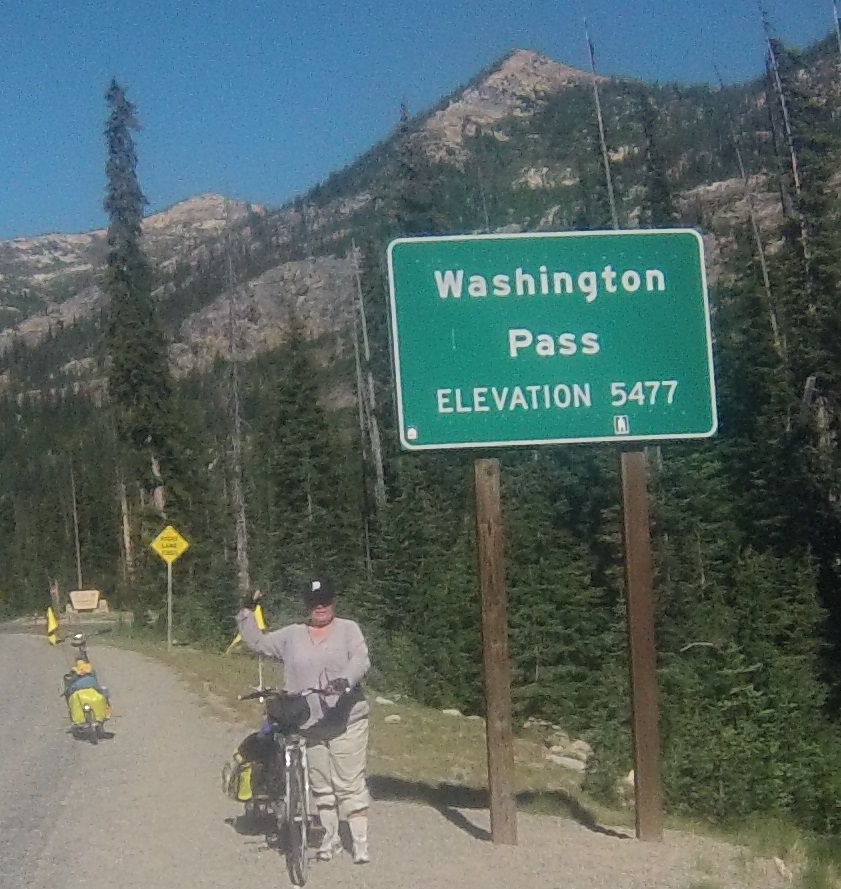
We sleep poorly and get up before dawn, anxious to start this long climb before the heat of the day.   It is a long climb all right, punctuated by incredible vistas and breathtaking beauty.  We push our bikes a lot.  The day stretches on and still we climb.   We can only ride for a few moments, it seems, before we have to stop and catch our breath. 

There are numerous cascades and rivulets pouring down the steep canyon sides.  At one point, we are so hot and tired, we simply go stand in a glacier-fed waterfall, letting the icy water pour through our helmets and down our shirts.

The day goes on and on, and so does the hill.  We have been climbing steadily since leaving Newhalem.  By this point, we cannot ride much, so we must walk.  It gets hotter and hotter.  We now scurry (as much as one can on a steep hill, pushing a bike with 40 lb. trailer) from shadow to shadow. 

Exhaustion fueled irrationality becomes a real presence.  I start making plans to hitch a ride.  How many vehicles can pick up two bikes, two riders, and two trailers?   Wes starts searching in the cliff-sides for a camping spot.  I tell him not to waste his energy, but he insists there must be a camping spot on these 45 degree slopes.

We trudge on.  We are at our wits’ and bodies’ limit, when we finally reach the Rainy Pass summit.  To our great relief, we see a picnic grounds.  It is neglected and the water taps don’t work, to our great surprise.  We are grateful we still have spring water gathered from the mountains.  Our tap water from the campground was long gone.  Wild gathered water is always a risk, but dehydration is a bigger and more immanent threat.

We eat a meager, but delicious, dinner in a pestilence of mosquitoes and biting flies, and look where to make our illegal camp.  The tent, somewhat hidden on the edges of the picnic ground, is a blessed relief after the rigors of the day and frustration of mosquitoes in our eyes, ears, and everywhere.   We had come 29 miles, all of it up hill, and much of it walked.   We sleep almost immediately.

The next day—today—we wake up, eat the last of our supplies, and begin the trudge up the next mountain pass.    It is only 5 miles—a veritable lark after yesterday—and when clear the top, we are astounded.    We are in a cirque of straight walled peaks whose serrated jaggedness is both appalling and wonderful. 

The ride down is something else.  It is a straight shot down the mountain: 16 miles.  We have to pull our bikes to a stop every so often because our hands have gone numb from the shaking and braking. Wes and I agree, during one stop, that it would be terrible to have to go up this steep hill.  At one point, I note that it is a good thing I have brought the speed down to a more reasonable level, and when I check it, I am still going close to 27 miles an hour. 
We have already decided we are going to take a room when we get to the bottom.  I saw Freestone Inn and Cabins on the map and said, “Let’s try there.”  When we pull in, we see it is a lovely resort next to the Early Winters stream.

We get a cabin next to the creek, wash ourselves, and happily drink a cold beer.  We wash our stinky bike clothes in the sink and put them out in the hot, dry air. (I’m sure our neighbors like the look of clothes strung on the porch of our cabin).  We enjoy a wonderful meal and visit at length with the other guests.  It is really nice, especially remembering that just twenty four hours earlier, we were lurking in an illegal camp with no food or water, after a long brutal day.
We still have no phone service, but the inn has Wi-Fi, so I am able to get email.  The services for Judy will be in Riverton, Wyoming on Saturday, July 27, 2103  at 9 am.  There is no way for us to get there. 

We wonder about the curious ways we make it through our lives.  There are no promises.   Whether our lives stretch through years and years, and slowly wind down, like Rose’s, or blink out in an instant in a bizarre accident like Judy’s; whether we rush toward them in great hope and expectation, or slog our way through duties and obligations, it still is just as Samuel Beckett said, “The light gleams for an instant, then it’s darkness once more.”

Thursday, April 25, 2013

T-59: The Meaning of Matter


We are now less than two months out from our big trip.  There is still a lot to do, but we making progress on all the easy fronts.  The easiest front of all is focusing on the stuff side of this equation.  What will we take?  How will we carry it?  

I particularly focus on this, making lists, and making piles and sorting, arranging, and measuring the pile.  Wes is very happy to let me do this.  I approach these matters with a combination of relish, fixation, and sheepishness. 

Beckett's playwriting/choreography for Quad
The relish part:  part of this is just the simple joy of numbers.  I, unlike so many, understood completely Samuel Beckett’s nostrum, uttered by his irrational character Watt, “there is nothing so comforting as numbers.”  Watt spends endless time trying to count steps (12 or 13 or 14, depending on whether you count the risers or treads), or figuring out the number of combinations of moves that will allow him to moving his sucking stones throughout his pockets without repeating either stone or pocket. 

I am embarrassed to say I understand this.  Ever since I was a little girl, I have been using math to help me cope with excess time, or stress, or boredom.  I remember when I was about 10 or 11 figuring out that there were 10 reflector poles per mile.  I would then figure how many poles there would be on this trip.  I would then do fractions in my mind to pass the miles.   

I still do this.  Yes, I truly do count swimming laps by doing fractions: 1/72, 1/36, 1/24, 1/18, 5/72, 1/12….  I suppose this is a mild form of autism.  It occupies the mind without engaging either the emotions or the body.
I like data.  I keep records.  It makes me feel grounded.  It is clear, finite, fixed.  It is not confusing and changeable, like people are, or interpersonal communications are.  My life is full of people.  Each one is wonderfully different and amazing.  Each one learns differently.  Each one communicates differently.  Some are good at it.  Some are not.  Some say what they are thinking and feeling.  A whole lot don’t.  I find it work to negotiate all these changes all the time.  I am amazed and jealous of people, like my friend Janice, who flow through the tides of diversity and emotion, with such grace and empathy. 

I find quite challenging to be a constant source of output.  My natural state is being a receptor, who then likes to arrange and systematize (see above), but who doesn’t much like to talk about it.  I do not have that whatever- it- is, that allows people to tell the same story over and over to different people.  This makes me a truly rotten promoter.  I have seen my friends like Rich and Keith go from person to person, happily sharing the same information over  and over, seeding a room with information.   I become either embarrassed, bored, or exhausted attempting this useful task. 
For better or worse and probably both, I have a wonkish, writerly turn of mind.  I can spend hours in silence.  I am overly stimulated, and as a result, way too talky and hyped up, when I get around a group of people.  Most people think that blatherskite is me.  That is the me they experience.…but it is not the comfortable and peaceful me.  It is the nervous and anxious and overcompensating me.

So part of this trip is just respite.  There will be days and days of  focusing on the simple, concrete need to deal with physical reality.  We need to pack the bike.  Is the bike packed? Check. We need to make our camp.  Is the camp set up? Check.  There are beginning, middle, and ends to these tasks.
Many hours on the bike are spent in silence, just being.  The body is active, the mind is quiet and receptive, perceiving the ever-changing panorama.  I love having a bike computer and watching the numbers go by and doing my fractions.    The ambivalences and endless interpersonal communications, with the constant negotiations and misunderstandings which make up the reality of my daily life will stop for a while.  I will revel in the concrete and rest in the simple meaning of matter.