September 20, 2016: Najera, Rioja, Spain
The first few days on the trail are a blur of steep ups and downs, interactions with “peregrinos” (pilgrims) of all ages, types, and ethnicities… the dislocations of adjusting to Spanish language and culture…and of course, physical exhaustion.
Our first clue we have entered some other reality happens in the little town of Viskarret. After our climb over the Pyrenees, we could only make 6 miles the next day. We ended up staying at a posada (inn) notable for a few things: shutting down the electricity at 10 PM (too bad for people who need to get up in the night), and intense conversations with the British, Canadian, American, and Austrian guests around this high-priced communal dinner table.
Earlier in the day, we discovered that the Brits who commented on my socks are in fact, Scottish and more than a little dotty. They are here in their motorhome, driving to various locations on the trail to offer advice, tell stories, hand out yellow and blue yarn flowers, and parade their fat little Jack Russell about. This is their twelfth or fourteenth trip to the trail.
We also learn that many people walk a short distance, don’t carry their luggage and feel no compunction to get to Santiago de Compostela. We also witness a rather heated political discussion with the London Sunday Times reporter, his sister from Canada, and American from California, and the 2 dotty Scottish.
When the conversation turns to Brexit and the Times reporter makes sure we know he has spoken to all the key players in the recent events. It wasn’t long before the topic was Donald Trump and his bigotry and shortly thereafter, Maggie Thatcher and her bigotry.
The Canadian sister makes a case about Maggie’s support of white supremacy. The dotty Scottish either do not hear or understand her point, and make a full throated statement of support of Margaret Thatcher. To the Californian and Canadian sister’s ears, it sounds like they are in support of white supremacy.
Jim the Californian slams down his unfinished beer, stands up, and pronounces, “I didn’t come all this way to hear this,” then leaves. The Canadian sister churns in her seat. When the Scots try to explain themselves, they only make it worse by saying, “I’m not a racist. We have a black deacon in our church.” The wife thinks she is helping when she say, “We have a black friend and he’s a grand fellow.” It’s clear they don’t know the difference between white separatists, white supremacists, and racists.
After a bit more of this, the Canadian sister leaves, disgusted. The journalist then interrogates the poor, dotty Scots who haven’t the intellect, language, or skills not to be skewered time and again by the cynical Londoner. “Do you mean that you thought Maggie’s policies benefited the lower class people? How do you account for the increase in unemployment?” To which they reply, “We liked her, she brought back strength to our country when we needed it.” He asks, “How do you account for the Falklands War?” It was like watching a cat knock about a flustered and increasingly frightened mouse.
Later that night, the journalist entertains the whole table with a long story of his uncomfortable night sleeping in a bunk bed in the massive dormitories of Roncesvalles. He is witty and well spoken… and used to being the center of attention. But he is also plainly unnerved by the Camino experience. He is furious the next morning that the electricity was out. He is angry butter is not served with the bread and the scanty breakfast is so expensive. His sister will not walk that day, overdone by the trip over the summit. He sets out alone, a beginning hiker with almost no Spanish and little tolerance for difference and ambiguity. Wes and I bet he won’t make the full week he has set aside for this walk.
After our short day, we decide we better have a full day. Because we are not feeling so great, we decide to send our bags ahead to our next lodging. We pull out a few things from our packs and place them in small carry sacks. It is a joy to make the steep ups and downs without the 20 extra pounds on our backs.
We are jaunting along. I am moving somewhat faster than Wes, and waiting across the highway when a car pulls up. A young Spaniard /Basque, his girlfriend, and his parents jump out of the car, and pull Wes over to ask him why he is walking the Camino. Wes relays that he doesn't know, but that something spiritual is calling him. The group ends up interviewing him on a small camera and by the time he re-joins me, he is crying. I try to determine why, but all he can muster is that is made him think about the enormity of our undertaking.
The trail is full of pilgrims —on bikes and walking. They range from 3 young Spaniards who make a sport of throwing rocks at trees to an elderly British woman with painfully swollen legs, hobbling up the steep hills, a small open umbrella attached to her pack and bobbing with each step. Her companion is murmuring constant encouragement.
When I pass two young American women, who have stopped to tend sore feet, I hear one say, “OMG, I can’t believe it. This is only the 2nd day!” Later, they pass me by, in intense conversation about a Danish fellow they had met in the dorms.
By the time we get to the little town of Zubiri, it is full of pilgrims on this hot fall day. It is also clear, we have made two significant mistakes. When putting together the light pack, I have brought neither my Camelback water bladder, nor any way to deal with pain.
I grow increasingly thirsty after a big climb. I am happy to join the throng of pilgrims visiting a food truck strategically placed at the top of the hill. I order a juice and get some fruit, and am trying to recover my equilibrium, when I am enthusiastically greeted by none other than the dotty Scottish. They mournfully tell me they won’t see me any more because they are now going over to the other big mountains on the trail…to offer their brand of comfort and encouragement, I suppose.
The walk into Zubiri includes a drop of 300 meters in just few kilometers. I try to “walk slalom” down the hills, but my injured toe is banging against my boot, and every step is a searing throb. My “medicine chest” is back with the backpacks, so there's no way to arrest or mediate the pain.
When I get to Zubiri, I have to walk to the far side of town to the town’s one “farmacia”— the only place one can buy ordinary drugs like ibuprofen.
When we sit down to lunch after my pain pill detour, we realize we have made another, even worse mistake.
Our lodging is still more than 8 miles away! I had had a great deal of trouble finding lodging the previous night. I finally found one in a town called Uharte, which was far, but seemingly not too far, if we aren’t carrying our packs.
However…
I had misread the map and miscalculated the distance by 5 miles… creating a walk with a total distance of 16 miles. With my throbbing toe, we would have happily called a stop at Zubiri, but we couldn’t. Our bags are on their way to Uharte. We have to get there….somehow.
When most sensible Spaniards and pilgrims are taking their siesta in the hot afternoon sun, Wes and I are walking down a treeless trail, next to a massive manganese mine, going through his one bottle of water at an alarming rate. We are about to clear the mine tailings when we hear a voice from behind call out, “Are you from Michigan?” This was startling until I remember that I am walking advertisement for UM School of Social Work. I am wearing a maize and blue string pack emblazoned with a big block M, a remnant of hosting social work interns at Matrix.
Diane is an American now living in South Carolina, but whose husband is from Gaylord, Michigan. She is traveling alone, on the 2nd day of her hike. We are on the 4th day of ours, even though we had all started at St. Jean Pied-de-Port. She is walking fast and light, but getting tired, and glad for some English conversation. We walk together for a while, but she soon finds our pace too slow and is soon out of sight. In the meantime, we cross and are crossed by a small group of young looking Asian woman, traveling with an slightly older Asian man.
At the town of Larrasoaña, it is already starting to
be late afternoon and we still have 4-5 miles to our lodging. We are beat and will never make it. Perhaps we can find public transportation or take a cab.
Once in town, there are distressed pilgrims walking up and down the streets. Most of the bars and cafes are closed and all of the lodging, albergues, and hostels are full. Before long, we spot the reason. The town is hosting its annual fiesta. Hundreds are seated at long tables under a big white tent.
Larrasoaña is a quaint medieval town in a cool mountain glen. Many of its stone cottages are 2nd home for people living in nearby Pamplona. Cars line the 12 foot streets, and more villagers, relatives, and part timers are arriving by the second.
After wandering the town and realizing there is no option but a taxi, we start trying to figure out how and where to get a cab in this country town. We are hot, tired, and worried. As I sit there, messing with my phone, a small car with 3 young people finds a place to park just in front of us.
Wes jumps up, runs over to them and says “Taxi?” Then signals making a call. Without any more interchange, the driver pulls out his phone, calls a cab, and tells us in broken English a cab will pick us here by the church in about 15 minutes. We are stunned and grateful. Our benefactors are gone in a moment.
While we wait for the taxi, we see Diane again, moving with a group of 10-15 pilgrims, none of whom has any place to stay. We tell her about our choice to take a cab, but she says no. She clearly thinks we’re cheating.
Well, maybe we are, but we are glad to. We never could have made it to our hotel, which as it turns out, is a wonderfully put-together and run old-world hotel on the outskirts of Pamplona, right beside the cool lush banks of the Arga River.
In our room, we collapse on the bed, take cool cloths to our faces, take long, cool showers, change into our “evening clothes,” and happily drink the complementary juices. An hour ago, we were in a mess. But once again, guardian angels/kind people/Wes’ impetuosity /dumb luck has seen us through.
With the sunrise tomorrow, we will walk into Pamplona and leave the Pyrenees' part of our journey. As per usual, the trip is taking us.
Total Pageviews
Showing posts with label exhaustion. Show all posts
Sunday, September 25, 2016
Sunday, September 18, 2016
You is Here
September 9th, 2017: Burguete, Spain
We made it over the top last night. By the time we crawled into the Hotel Loizu in Burguete, we were beat. We had come 12 miles and we were aching and sore all over our bodies.
Yesterday, we spent a lovely night in a fully a furnished apartment in Valcarlos, Spain.. We made a cheap, but effective dinner, which required a visit to 3 stores in 2 walks up the hill.
The apartment had a washer and a coffee maker, both of which seemed incredibly luxurious. So we washed our clothes the European way, which takes a full hour for each load, while we make several cups coffee in a tiny espresso maker. We flavor the coffee with thick, sweetened evaporated milk from a tube.
Afterwards, put our clothes out to dry in the blaring heat. (on thoughtfully provided drying racks) while we drink our delicious coffee in a tiny back courtyard defined by a 20 foot stone cliff and the gray walls of the apartment. A metal spike fence separates each apartment’s courtyard and makes the scene look like a prison yard. However, it was about 20 degrees cooler than the front terrace where we were our clothes were drying, so we didn't mind the austere greyness.
The next morning,
Wes and I are awake before 6, planning to get started before the traffic does, as part of the day will be walking on a curving, climbing, shoulderless road.
We don’t make it out until 7:30 AM, just as the sun... if there were sun... was peeking over the steep canyon walls. Instead, it is misty and a bit foggy. We are grateful to be wearing lights. Wes is wearing a mini lantern on the back of his backpack and I have rigged up a pin headlight on the front of my shirt. The barrelling lorries and cars see our lights in the mist and slow down.
Just before we turn to take a forest track, we come across two Americans, from South Carolina, Steve and Alice. They had missed the turn to the side track yesterday and so had mostly walked on the road to this point. They are about our age and laugh when we commiserate about the 60 year old pace. But they also do not seem like experienced outdoor people or travelers. Steve has his enormous pack off and is rooting through it to find the guidebook instead of keeping it ready reach in one of the pack’s exterior pockets.
Our goal for the day is clearing the Ipañeta pass, which will bring us to the south side of the Pyrenees. We are glad to leave the highway, which has grown increasingly busy as the day progressed. It is unnerving to walk on the shoulderless road, where one side is a guardrail over a cliff and the other side abuts a mountain wall.
We enjoy ourselves on the forest track, where ferns and stinging nettle abound. The trees are a mix of beech, sycamore, and something like an alder. We walk past many ancient farm buildings, made of stone and roofed with mossy orange tiles. They perch in little openings on the canyon floor and often climb to 3 or 4 stories. On some, we can see that the older stone has been covered with a white lime plaster.
The designs of these white houses are far more variable than those in the Loire Valley, where square houses and hip roofs dominate. These houses seemed to have begun on the chalet model, one or two stories with a center front entrance under steep eaves. But over time, they twist this way or that, add dormers, extensions, floors, and additions following the lay of the land and the whim of the owner.
Our ever climbing path wanders in and out of the farmsteads and compounds. Sometimes we are on a wide path beside a creek. Other times, we make our way up a single track on a narrow and steep path where I must warn Wes about overhanging, face-slapping stinging nettle.
By 11am or so we leave our little stream, and enter the pass region of the hike. We are following a line of high tension power poles, on a rough track that grows increasingly steep and rocky. I am very grateful for stick I found to supplement my single trekking pole. Very often, I need four limbs on this rough and treacherous terrain.
We are panting, heaving wrecks, about to enter the steepest in remote part of this hike. I am waiting for Wes puffing his way up the hill, when two Francais come jaunting by in sneakers, and the lightest of day packs. She is about 45; her pendulous breasts are swing braless under a light T shirt. The young man, probably her son, has a significant pronation on his left foot, so much so, it looks like his ankle nearly reaches the ground with each step of his wet tennis shoe. They trill a cheery “Ca va?” at us, and are soon out of sight.
No one could accuse us of jaunting up the path, but we make steady progress, although our too scanty breakfast is long gone and we are getting low on water.
The last few kilometres to the top are a real grind, made more challenging by the misty rain turning to light, then not-so-light rain. I insist we cover our packs with their protective rain cover. Wes doesn’t want to make the effort. It takes me a few seconds to cover his, but when Wes fumbles to remove the cover, but when Wes fumbles to remove the cover from its pocket at the bottom of my pack, I holler, “Do have to take this pack off and do it myself?” Thank goodness, Wes does not return fire and soon this hunger and exhaustion fueled snappishness slips into the mist.
We are glad to make it to the 1055 meter summit, but the view is just a few 100 feet. The ancient stone chapel looms in the mist and nothing tells us to stick around. A skinny Spaniard in a short poncho appears in the mist, and almost starts walking back down the mountain until we shout him back on course.
Once again, we are glad we did not take the upper route, whose chief virtue is panoramic views and whose is chief vice is a steep 500 meter descent. As it is, each step of the descent hurts.
At the sight of the ancient monastery, now pilgrim haven at Roncesvalles, my heart leaps. When I see its square tower and long dormitories, I start looking forward to some coffee and real food. The handful of raspberries plucked along the way were helpful but not sufficient.
When we land at the pilgrim office, we are suddenly in a sea of soggy backpack wearing…or shedding... travelers. A big group huddles on a bench in the corridor, eating sandwiches and apples. More than a few have the same hollow-eyed look of exhaustion we do.
There is a big circle of pilgrims lining a tall table in the pilgrims' office. I move to an open spot where I am informed in curt Spanish by a sweet faced 20 year old woman, “This is a line and I have just cut in place.” It takes me a moment to process what she saying and ask her in French, “Where is the end of the line?” About 20 pilgrims back. I don't have the mental or language capacity to explain that all I want is the pilgrim stamp, while most people are trying to arrange lodging and breakfast in the vast dormitories.
One hale and hearty Spanish woman is managing the whole affair in bad English, moderate French, and rapid fire Spanish. One big, young, damp American asks for lodging in careful Spanish and stands blinking and shocked at the torrent she returns in response. He then begs, “mas despacio, por favor” (more slowly, please).
I wait and wait. Wes comes in several times to see what on earth is going on. The line begins to snake out the door. At last the volunteer calls out, “No dormir?” I wave my pilgrim passport in the air…it seems I am the only one in this giant line not seeking lodging.
She moves me to the front of the line, stamps my passport in one second. Then we are gone, across the courtyard and straight into a bus load of elderly Spanish tourists huddling under umbrellas in their straight skirts, neat trousers and sensible shoes.
The rain increases along with our need for some food. We find an open restaurant/bar. The bar is jammed, but the dining room is nearly empty. We take seats to discover all they are serving is a 3 course meal with bread, wine, and water...
€18 each. Eeek. Oh, well, better that than a cold sandwich and beer for 10 euros.
The food is delicious. I have lentil soup with sausage and peppers, trout and flan, while Wes revels in his fruit and cheese salad, stuffed pepper, and chocolate gateau. We drink a whole bottle of wine, fuss over our lodging arrangements for the night and meet a threesome sitting next to us speaking flat Midwestern English.
He looks like he walked, but the 2 women are much too pristine to have braved the rainy trails. When we announce we are from, they say they are from London, Ontario. We say we met another group from London, Ontario, staying at the same apartment complex we were. The champagne blonde on the left starts, then stares, then says, “That was us!”
Neither group recognized each other out of context. We visit a bit. They will stay in the town just beyond where we will, but I have a feeling we’ll be seeing them again...
Just outside the restaurant, Wes talks to a couple of Brits in ponchos and their fat little Jack Russell terrier, who is sporting a Camino seashell on his collar. Wes asks if the dog is walking. He isn’t…too old at 14 years, but they’re all back again after many trips to the trail.
They correct Wes on his pronunciation of "Buen Camino" and teasingly point out that one of my pant legs is up and the other down. The wife says, "Well, it’s just to show that her pink socks match her pink blouse, isn’t it?”
The path to our lodging is flat and lovely, through a thick forest once noted as a haven for witches…(as the Inquisition would have history believe, more likely non compliant Basque women, I sniff to Wes.)
We stop to read the town’s signmap, which proclaims in English. “You is here.” and we surely are. We make our way through this charming Basque town where Hemingway spent so much time, and find our lovely hotel. It takes seconds to shed our wet clothes and heavy boots. In minutes. I am soaking, then snoring, in the deep cast iron tub.
After muscle rubs, healing ointments, and ibuprofen, we snuggle into comfortable but adjacent twin beds. We are glad to be over the mountain and truly started on our pilgrim journey.
We made it over the top last night. By the time we crawled into the Hotel Loizu in Burguete, we were beat. We had come 12 miles and we were aching and sore all over our bodies.
Yesterday, we spent a lovely night in a fully a furnished apartment in Valcarlos, Spain.. We made a cheap, but effective dinner, which required a visit to 3 stores in 2 walks up the hill.
The apartment had a washer and a coffee maker, both of which seemed incredibly luxurious. So we washed our clothes the European way, which takes a full hour for each load, while we make several cups coffee in a tiny espresso maker. We flavor the coffee with thick, sweetened evaporated milk from a tube.
Afterwards, put our clothes out to dry in the blaring heat. (on thoughtfully provided drying racks) while we drink our delicious coffee in a tiny back courtyard defined by a 20 foot stone cliff and the gray walls of the apartment. A metal spike fence separates each apartment’s courtyard and makes the scene look like a prison yard. However, it was about 20 degrees cooler than the front terrace where we were our clothes were drying, so we didn't mind the austere greyness.
The next morning,
Wes and I are awake before 6, planning to get started before the traffic does, as part of the day will be walking on a curving, climbing, shoulderless road.
We don’t make it out until 7:30 AM, just as the sun... if there were sun... was peeking over the steep canyon walls. Instead, it is misty and a bit foggy. We are grateful to be wearing lights. Wes is wearing a mini lantern on the back of his backpack and I have rigged up a pin headlight on the front of my shirt. The barrelling lorries and cars see our lights in the mist and slow down.
Just before we turn to take a forest track, we come across two Americans, from South Carolina, Steve and Alice. They had missed the turn to the side track yesterday and so had mostly walked on the road to this point. They are about our age and laugh when we commiserate about the 60 year old pace. But they also do not seem like experienced outdoor people or travelers. Steve has his enormous pack off and is rooting through it to find the guidebook instead of keeping it ready reach in one of the pack’s exterior pockets.
Our goal for the day is clearing the Ipañeta pass, which will bring us to the south side of the Pyrenees. We are glad to leave the highway, which has grown increasingly busy as the day progressed. It is unnerving to walk on the shoulderless road, where one side is a guardrail over a cliff and the other side abuts a mountain wall.
We enjoy ourselves on the forest track, where ferns and stinging nettle abound. The trees are a mix of beech, sycamore, and something like an alder. We walk past many ancient farm buildings, made of stone and roofed with mossy orange tiles. They perch in little openings on the canyon floor and often climb to 3 or 4 stories. On some, we can see that the older stone has been covered with a white lime plaster.
The designs of these white houses are far more variable than those in the Loire Valley, where square houses and hip roofs dominate. These houses seemed to have begun on the chalet model, one or two stories with a center front entrance under steep eaves. But over time, they twist this way or that, add dormers, extensions, floors, and additions following the lay of the land and the whim of the owner.
Our ever climbing path wanders in and out of the farmsteads and compounds. Sometimes we are on a wide path beside a creek. Other times, we make our way up a single track on a narrow and steep path where I must warn Wes about overhanging, face-slapping stinging nettle.
By 11am or so we leave our little stream, and enter the pass region of the hike. We are following a line of high tension power poles, on a rough track that grows increasingly steep and rocky. I am very grateful for stick I found to supplement my single trekking pole. Very often, I need four limbs on this rough and treacherous terrain.
We are panting, heaving wrecks, about to enter the steepest in remote part of this hike. I am waiting for Wes puffing his way up the hill, when two Francais come jaunting by in sneakers, and the lightest of day packs. She is about 45; her pendulous breasts are swing braless under a light T shirt. The young man, probably her son, has a significant pronation on his left foot, so much so, it looks like his ankle nearly reaches the ground with each step of his wet tennis shoe. They trill a cheery “Ca va?” at us, and are soon out of sight.
No one could accuse us of jaunting up the path, but we make steady progress, although our too scanty breakfast is long gone and we are getting low on water.
The last few kilometres to the top are a real grind, made more challenging by the misty rain turning to light, then not-so-light rain. I insist we cover our packs with their protective rain cover. Wes doesn’t want to make the effort. It takes me a few seconds to cover his, but when Wes fumbles to remove the cover, but when Wes fumbles to remove the cover from its pocket at the bottom of my pack, I holler, “Do have to take this pack off and do it myself?” Thank goodness, Wes does not return fire and soon this hunger and exhaustion fueled snappishness slips into the mist.
We are glad to make it to the 1055 meter summit, but the view is just a few 100 feet. The ancient stone chapel looms in the mist and nothing tells us to stick around. A skinny Spaniard in a short poncho appears in the mist, and almost starts walking back down the mountain until we shout him back on course.
Once again, we are glad we did not take the upper route, whose chief virtue is panoramic views and whose is chief vice is a steep 500 meter descent. As it is, each step of the descent hurts.
At the sight of the ancient monastery, now pilgrim haven at Roncesvalles, my heart leaps. When I see its square tower and long dormitories, I start looking forward to some coffee and real food. The handful of raspberries plucked along the way were helpful but not sufficient.
When we land at the pilgrim office, we are suddenly in a sea of soggy backpack wearing…or shedding... travelers. A big group huddles on a bench in the corridor, eating sandwiches and apples. More than a few have the same hollow-eyed look of exhaustion we do.
There is a big circle of pilgrims lining a tall table in the pilgrims' office. I move to an open spot where I am informed in curt Spanish by a sweet faced 20 year old woman, “This is a line and I have just cut in place.” It takes me a moment to process what she saying and ask her in French, “Where is the end of the line?” About 20 pilgrims back. I don't have the mental or language capacity to explain that all I want is the pilgrim stamp, while most people are trying to arrange lodging and breakfast in the vast dormitories.
One hale and hearty Spanish woman is managing the whole affair in bad English, moderate French, and rapid fire Spanish. One big, young, damp American asks for lodging in careful Spanish and stands blinking and shocked at the torrent she returns in response. He then begs, “mas despacio, por favor” (more slowly, please).
I wait and wait. Wes comes in several times to see what on earth is going on. The line begins to snake out the door. At last the volunteer calls out, “No dormir?” I wave my pilgrim passport in the air…it seems I am the only one in this giant line not seeking lodging.
She moves me to the front of the line, stamps my passport in one second. Then we are gone, across the courtyard and straight into a bus load of elderly Spanish tourists huddling under umbrellas in their straight skirts, neat trousers and sensible shoes.
The rain increases along with our need for some food. We find an open restaurant/bar. The bar is jammed, but the dining room is nearly empty. We take seats to discover all they are serving is a 3 course meal with bread, wine, and water...
€18 each. Eeek. Oh, well, better that than a cold sandwich and beer for 10 euros.
The food is delicious. I have lentil soup with sausage and peppers, trout and flan, while Wes revels in his fruit and cheese salad, stuffed pepper, and chocolate gateau. We drink a whole bottle of wine, fuss over our lodging arrangements for the night and meet a threesome sitting next to us speaking flat Midwestern English.
He looks like he walked, but the 2 women are much too pristine to have braved the rainy trails. When we announce we are from, they say they are from London, Ontario. We say we met another group from London, Ontario, staying at the same apartment complex we were. The champagne blonde on the left starts, then stares, then says, “That was us!”
Neither group recognized each other out of context. We visit a bit. They will stay in the town just beyond where we will, but I have a feeling we’ll be seeing them again...
Just outside the restaurant, Wes talks to a couple of Brits in ponchos and their fat little Jack Russell terrier, who is sporting a Camino seashell on his collar. Wes asks if the dog is walking. He isn’t…too old at 14 years, but they’re all back again after many trips to the trail.
They correct Wes on his pronunciation of "Buen Camino" and teasingly point out that one of my pant legs is up and the other down. The wife says, "Well, it’s just to show that her pink socks match her pink blouse, isn’t it?”
The path to our lodging is flat and lovely, through a thick forest once noted as a haven for witches…(as the Inquisition would have history believe, more likely non compliant Basque women, I sniff to Wes.)
We stop to read the town’s signmap, which proclaims in English. “You is here.” and we surely are. We make our way through this charming Basque town where Hemingway spent so much time, and find our lovely hotel. It takes seconds to shed our wet clothes and heavy boots. In minutes. I am soaking, then snoring, in the deep cast iron tub.
After muscle rubs, healing ointments, and ibuprofen, we snuggle into comfortable but adjacent twin beds. We are glad to be over the mountain and truly started on our pilgrim journey.
Friday, November 8, 2013
T+137. Lost and Found and Lost
Centennial, Wyoming: We have just witnessed two days of gale
force winds. Yesterday, the snow was
blowing so bad we could not see more than 100 yards. We sat at the windows and heard the house shake. We watched for and worried about the Angus
yearlings on the next ranch, who were huddled up in the willows. When we went shopping, we made sure we prepared
our car for the worst: (shovel, blanket, kitty litter, emergency kit.) Here, the earth is in charge and we best not
forget it. Getting lost or stuck out
here is no laughing matter. In central
New York, we found out a little something about losing and finding. It wasn’t funny at the time.
Mile 3757: Rome, New
York
We leave Fulton
early on a Saturday morning. It is grey
and a bit chilly. We will follow the
north shore of Lake Oneida to Rome. This
was not our original intention. We are
going to Rome because it was the only place we could find lodging. Everything on Lake Ontario was full because
of salmon fishing, and everything in Syracuse was full because of the football
game. We were able to get a room in
Rome, partially because the local historic attraction, Fort Stanwix, is closed
because of the government shutdown.
Because the Fulton motel had no WiFi, I had to use the internet at the
gas station across from our motel. I play “hotel bingo”, book an expensive hotel
in Rome, and lose.
We will have to make
a long ride to get there, then use Rome as our launching point into the
Adirondacks. We leave Fulton as the sun
was coming up, and enter rolling farm and woodlands, scattered with a series of
tiny towns. There is much poverty and
abandonment along the way. In the hamlet
of Central Square, the volunteer firefighters are hosting a chicken barbeque to
provide support for a member whose child has cancer. This must be the tenth chicken dinner benefit
we have encountered.
The chicken is not
yet ready, so we ask at the local gas station about local cafes, and the skinny
woman, whose bright smile was missing a few teeth, first tells us what used to
be in the village, before telling us we can find a breakfast down by the
freeway in a few miles. The place is
busy with lots of football fans and motorcycle riders. We sit down to order and a family with adult
children sitting next to us immediately begins peppering us with
questions. They are from Wilkes-Barre,
Pennsylvania. They are up to spend a
final fall weekend before closing their cottage on Lake Oneida. They get into a debate with our
waitress. Is cycling across the country
brave, stupid, or crazy? I think they
decided that the right answer was all three.
As we go out the door, a young woman just dismounting a motorcycle asks
where we are going. When we tell we are
going to Rome, she asks “Today?” As we
cycle off, we hear her say to her compatriots, “I think I would bike 10 miles…no, make that 5
miles…before I would give up.”
The north shore of
Lake Oneida is ringed with cottages and small villages. There are a number of resort attractions that
have long since decayed. We stop and
stare an immense Dutch style barn, at least 200 feet long, with faded lettering
announcing dancing, fine food, and drinks.
The tangled web of ivy growing over the building tells us it has been a
few decades since this hand-hewn building was a destination. There are few places to stop, and where there
are active business, many have closed for the season.
Thus, Wes and I are relieved
when we finally find a place to stop for lunch: a small bar not far from the
shore of the lake. The place is small,
dark, and empty. The female bartender is
at first quite perfunctory when we discover that the only food available are
cheese puffs and pickled eggs. We drink
a beer on an empty stomach. Before long,
a vivacious couple who knows the bartender quite well enters the bar. Soon we are in the middle of lively conversation
about the economy, jobs, dogs, and what-not.
The man runs out to his truck to get his “darlin’”, a tiny, jittery Chihuahua
who runs up and down the counter and jumps into his arms on command. He says he is “retired,” although it means he
has just quit looking for work after his last lay-off. He says he might work again, if he could find
anything. His wife snorts at the
thought. We order another beer for the
two of us, but the bartender gives us each another beer.
I am wee bit tipsy
when we leave, giddily waving to the laughing couple. We jump on the bike and have a great ride,
winding up and down through empty roads and the coloring forest. We come to a pretty meadow that shows the
trees to their advantage. I suggest we
stop and get a picture. After I get off
my bike, I am horrified to see that I have left my pannier, along with my
purse, back in the bar. I know exactly
where it is. We originally sat at table
when we entered. When the chatterboxes
came in, we moved to the bar, but my pannier didn’t.
Wes
picks up the story:
What to
do. . .what to do? I walk across the road, stick out my thumb, and the first
car by stops. It was an off-duty county sheriff. I told him our problem, and he
said, "We'd better get you there before one of those unemployed people
discover it". He took off like a
rocket and we covered the ten miles, in ten minutes. He dropped me off, but
couldn't take me back because he was meeting his son to fix his son's broken
down car. Luckily, the pannier/purse was still leaning against the wall, but
the minute I picked it up, Shaun's phone rings. Everyone in the bar turned and
looked.
I smiled
and said, "It's for me".
But I
still had to get back to Shaun, so I step out and try to wave someone down.
Some kids living in a run-down apartment adjacent to the pub saw me and ran to
their mom and told her some wild looking man was trying to stop cars like he'd
been in an accident or something. The mom came out and asked if everything was
all right.
I
explained and told her my wife was on the side of the road waiting. She
immediately dropped what she was doing, called her mother to babysit, and said
she'd take me. We got into her beat-up old car and took off. She mentioned she
hoped she had enough gas. A few minutes later, we pull up to Shaun with the
pannier, thanked the lady profusely, and gave her gas money, which we hoped
would keep her fueled up for the week.
Total time since Shaun discovered
the missing purse?--25 minutes.
Feeling
grateful that my foolishness had not done us in (once again), we are soon back
on the bikes. Truly, God takes care of
fools and little children. It is getting
to be late afternoon, and we still have close to 20 miles to go. As we leave the shores of the lake, we go
through a marshy area. It is horrifying:
the road is be-smattered with thousands of frog carcasses. The gore lasts close to a mile. We wonder if the cars even see these small
guys. We certainly do, and wonder why
there are not viaducts under the road in obvious migration routes like this,
especially given frogs’ state of near extinction.
We
have travelled 45 miles, 35 miles since breakfast, when we see a store which
has been in business since the 19th century. The building has been made and re-made, but
here at the conjunction of river, lake, canal, and road, it is easy to see why
folks have been stopping here for generations.
We grab sandwiches and eat on our bikes.
Time is slipping away.
When
we finally make our way to Rome, we are relieved. We have travelled 60 miles, lost and found my
purse, and are ready to get to our hotel and prepare for our push into the
Adirondacks tomorrow. I call the hotel
to get directions. The young desk clerk
gives me simple directions, but they don’t make sense where we are. I tell we have just entered the town on
highway 49. She says, “Good, just take
the Griffiss Park exit, you will find us on the right.” I don’t understand how we can take an exit
if we are already in town, and she repeats her instructions again.
We
figure we’ll find it soon enough, so start making our way through the small
city of Rome. This is an old city, built
over an old fort, built over a central location for the Six Nations Confederacy
of the Iroquois. At this point in time,
there are lot of abandoned warehouses, many rail lines, shuttered factories
interspersed between various business and eateries. It looks alive, but very much in
transition. We ride a long way and see
no sign of the hotel. We stop a mom and
daughter combo going into a fancy barbeque place for help. They both whip out cell-phones, then struggle
to tell us how to get there, with the admonition that it is pretty far. We get some more instructions, which are a
bit confusing and keep going. We have
now ridden several more miles since entering the town.
We
come to the restored grounds of Fort Stanwix and have to make a decision which
way to go: freeway, small street, or main street. The website seems to say “small
street”, the ladies said “main street”, the clerk seemed to say “freeway”. Wes goes into a Laundromat to seek further
assistance. Apparently, he does not hear
me say I will wait on the corner before the Laundromat. I wait and wait, check the website, call the
hotel, try to use my phone to figure out what to do. I walk to the Laundromat. No Wes.
I look up and down the street. No
Wes. The sun is going down. I call his cell phone. It is off.
Oh, boy, now I am really getting upset.
I don’t know how to get to the hotel; I don’t know where my husband is;
I am tired and in a somewhat dodgy location.
I call again. Still no
response. A while later, starting to get
a bit panicked, I call again and to my relief, I am able to leave a “where are
you, where are you, where are you?” message.
By
time Wes calls me back some minutes later, I am crying. He had come out of Laundromat
and not seen me. Thinking I had gone on,
he had hurried up the hill to find me. After
he had gone a long way with no sight of me, he too began to worry, and stopped
to turn on the phone.
We
start following the road and it is clear that we have left the main part of
town. It is quite dark now. My emotional stability is deteriorating
rapidly. We fumble our way to an
unmarked roundabout and can’t tell which way to go. Wes calls the hotel again and gets the same
poor instructions, although it is clear that we are getting closer.
My
tears and panic have returned as we fumble along in the dark, unable to find a
big hotel in the ever increasing remoteness of the landscape. Wes doesn’t know what to do with me. I don’t know what to do with me. We finally spot a sign to the Rome Free
Academy, which I recognize from the website as adjacent to the hotel. We make our way there at long last, we are
cold, hungry, and upset. The desk clerk
stares at us with big eyes, afraid we are going to yell at her. Wes has told me to just keep my mouth closed
and I know he is right. I say nothing. Wes is kind to her, although he tells her
that a basic skill for a desk clerk is understanding the layout of the city
enough to give directions. She doesn’t
apologize, but she does let us store our bikes in the board room overnight.
The
hotel is in a corporate convention center outside of city of Rome. We have travelled 10 miles from our entry
into the city on the northwest side to former air force base, now business park,
on the far southeast side. It wasn’t until
we got into our expensive, soul-less room that we understood that. Our disappointment grows when we discover
that there is no restaurant, no bar, no nothing in the facility, nor within
walking distance. They have an
expensive cantina, where we get some frozen dinners. This is not a happy night for the
Nethercotts.

The
next day, we awaken to a pouring rain.
This is not the day to bike into the mountains. We hang around, watch movies and
football. Late in the afternoon, the
rain has relented, and we are a bit stir crazy. We ask the same desk clerk for a coffee house
we can walk to. She gives us vague
instructions to a coffee house in the business park. We make our way there, walking through a moderately interesting sculpture garden. Of course, it is closed.
Saturday, September 7, 2013
T+71: Dash across North Dakota, Part 1
Mile 2180: MOORHEAD, MN
After the difficulties, delays, and delights at the
borderlands between Montana and North Dakota, both Wes and I are worried about
time slipping by. We plan to leave our
lovely room in Medora around 6 am. We
climb out of the bottom of the badlands and travel about 12 miles to the
incredible view at the Painted Desert viewpoint, when we hear a
beep.beep.beeping of a car. We turn to
look and it is Terrie and Ricki, our original benefactors, coming to say
goodbye and wish us well. We exchange
numbers and emails and hugs. They drive
off and we press on.
The route has us riding Interstate 94, which is both fast
and kind of hateful. The shoulder is
very wide, but there is lots of debris. It is amazing what we see along the
sides of the road. More cans and bottles
that you can imagine. All manner of dead
animals, especially deer, raccoons, and countless birds. I have been keeping count of the number of single
shoes I see: 38 thus far. As we pass the
fields of corn, soybeans, and wheat, we are also crossing fields of
grasshoppers. Some seem suicidal,
jumping into our rolling wheels. We note
that grasshoppers are cannibals and can be seen eating the carcasses of their
brethren. There are clothes, and bags,
and innumerable cell phone bits.
At Dickinson, ND, a rapidly growing boomtown with a giant
plastic land on its outskirts, we hang out in various fast food joints while we
wait for the temperature to drop below 90 degrees. We agonize whether to stay on the interstate
or take the route through the farmland.
At around 5pm, with temperature still over 90 degrees, we come to a
crossroads. Do we stay on the somewhat
hateful but fast interstate, or do take the scenic backroads which are more
beautiful and interesting, but much more difficult. As the founders of a theatre dedicated to
the creation of new work, which do you think we take? The unofficial motto of Matrix Theatre
Company, as we jokingly say, is “We do
it the hard way.” You know we took the
scenic route, though we were tempted by the fast and ugly route.
We head out, over hill and dale. It is Sunday, and we did not pick up any food
in Dickinson, assuming we can stop in the little town of Taylor when we get
there. By the time we are ten miles out
of Taylor, we are out of energy. We
count the miles to the little town. When we get the town itself, everything is
closed. It is still another 15 miles to
the next stop, where we plan to stay.
Running on empty is a damn good way to lose weight. As we approach the little town of
Richardton, we see for miles a beautiful double spired granite church
building. It is a Benedictine Abbey,
tall and elegant against the evening sky.
It seems out of place in this land of corn and sunflowers. We find out later, much later, that the Abbey
takes guests. (We are jealous when we
hear this.) We get to Richardton on a wing and prayer and pull into the only
thing open in town: the local tavern.
The only food is frozen pizza, which tastes damn fine at this point in
the game.
When we pull up to our motel, we are happy to note that it
is next door to the Hamburger Butcher Shop.
It is not what you think. The
name of the family is Hamburger. We were
lucky enough to have dinner with them in a crowded restaurant back in
Medora. This was three generations of a
family who described themselves as German Russians. The wife’s family name was Gaab and they come
from land now considered part of the Ukraine.
Apparently, this part of North Dakota attracted many people from that
part of the world. There are four people
in this group, mother, daughter and husband, and their son, Truman
Hamburger. Truman is all of 9 years old,
bright and verbal well beyond his years.
He tells us of his entomology classes and his day being a bat boy for
the Minnesota Twins. He is fascinated by
our trip and asks more questions than his parents and grandmother would
like.
Right after we make our payment, we open the door and there
is Truman. He saw us ride by and came running out to greet us. He runs back to tell his parents, who stop by
and who treat us to coffee the next morning.
As luck would have it, both times the Hamburgers come to visit, I am in
the processing of changing clothes. Wes
has to do all the relationship building. We exchange emails and promise to be Truman’s
pen pal.
After Richardton, we cycle through ups and downs, mostly
facing a pretty stiff wind. We see an
outcropping of phragmites near a railroad crossing, the first view of this
invasive species we have seen since leaving Michigan. At the next restaurant, we warn the locals
about this bane of a giant reed, but they don’t have the slightest idea what we
are talking about. I still feel I should
write the North Dakota Department of Environment.
When we cross the freeway, both Wes and I decide we have had
it, and that expeditious and easy has its purposes. The ride on interstate 94 is tedious and
noisy. However, the long hills are
moderated and evened out for truck traffic.
North Dakota is an ocean frozen in time.
The waves rise to the west in north/south undulations. We pull up a big hill, scoot down the other
side, over and over.
It starts to rain.
Interstate bicycle riding is even less pleasant when being splashed by
giant eighteen wheelers. We are very
happy to stop at New Salem, where the most remarkable feature is a 30 foot tall
plastic dairy cow on a bluff. The room
is great; we have a nice visit with touring motorcyclists.
The next day is an epic run through deep valleys in sharper
and sharper undulations as we enter the Missouri River valley. The river is massive at this point. The bike route takes us through a series of
parks, golf courses, and wetlands. We
are so happy to be in shade, real shade from real trees, the first in many,
many miles.
We have ridden 40 miles
before breakfast (truly lunch by that point), so we decide to stay, despite the
relatively short distance covered. We need to do some re-supplying. We visit the local mall (a complete shock); I
get new shoes. We get a room at one of
Bismarck’s landmark motels, The Ramkota.
This is a big fancy motel, circa 1968.
We enjoyed our stay immensely and wondered if it was being outcompeted
by the plastic-land motels and suites that have grown up around it.
The next day is one of the most difficult of the bicycle
trip. It is HOT. We leave Bismarck early and have fun for the
first few hours. The landscape is
challenging and there are few services.
There will not be a place to get anything until the little town of
Hazelton, some 45 miles from Bismarck.
When we turn on to highway 89, also known as the Lawrence Welk highway,
the sun is blazing, we have drunk most of our water and we still have 12 miles
to go. We going south, facing directly into the sun and hot wind. I can barely
go and Wes is getting further and further ahead of me. At one point, he looks back and cannot even
see me. He circles back to see me
struggling along the highway, plugging away, but moving slowly. It is tough going, but what is the
choice? All we can do is plug away.
We have dreams of a sandwich and cold drink dancing in our
heads. We make it to town completely
beat and find out Little’s Joe restaurant is closed. At the grocery store, we drink several juices
and eat ice cream and are thrilled to find out they make smoothies. (They make
the best orange crème smoothies in the world.) All sorts of people come over and check on
us. They ask about our trip, but really,
I think they are worried about the two red-faced and sweaty bicyclists in their
midst.
I am done in. I feel
dizzy and need to lay down. I go outside to rest on a bench. A paunchy fellow with shorts pulled up well
over his capacious belly comes and sits by me.
He is a retired earth science teacher. He tells us that North Dakota is quite
anomalous, both geographically and hydrologically. For one thing, much of this state’s water
drains, not to the Mississippi, but to Hudson Bay. When we leave the high perch that is
Hazelton, we leave the Missouri River drainage.
We will come across an ever increasing number of ponds, pools, and small
lakes, many of which are not fed by surface water. In fact, Devil’s Lake, in north central North
Dakota, is completely fed by underground waters and even so, has risen several
feet in the past few years. The town is
now below the surface of the lake, which is held back by dykes. North Dakota, by rainfall alone, should be a
desert, unable to grow wheat, much less corn and soybeans. However, it sits on a layer of clay which
holds the water and which is fed by underground waters. This is what makes the miles and miles of
cropland possible…and why North Dakota is so much more lush and green than
South Dakota.
He tells us that the Bakken Field, the source of the huge
boom on the west side of the state, has enough oil for 75 years and when that
is done, they have discovered another pool of oil beneath that one. He has no patience for wind or solar energy. When we point out that this would be prime
territory for both, he laughs and asks, “And what good would that do me in the
middle of winter, eh? Without batteries,
the whole thing won’t work.” About that
time, an elderly neighbor interrupts our conversation and requests his
assistance to back up her car. Even
though we have learned a lot, we are relieved when he goes to help her.
To Be Continued…
Friday, August 2, 2013
T+40: A Tale of Towns and Passes, Part 2
The coffee shop closes at 5pm, so we have to go. It is still over 100 degrees. We decide to make a quick shot to the next
town, where there is a grocery store.
We push as fast as we can. We
pass through a landscape of rickety shacks, nice houses with watered lawns,
industrial fruit farms with pickers’ cabins.
There are super skinny, burning-eyed young people all over the place. We assume that these are some of the many
“tweakers” mentioned by the barrista.
I make a wrong turn off the main highway, and we find
ourselves in “Tweakerville”, suddenly having to push our bikes up a rough, dirt
grade, in an neighborhood of beat up little houses with beat up old trucks, and
old furniture, trash, and junk in the front yards. We see a 7- 11 across the way and make our
way to it, as fast we can. We are
panting and sweating profusely.
Inside, we drink as much as we can, eat ice cream, take cold
rags to our overheating bodies. It is
close to 6pm and there is a steady stream of working and poor people of
European, Latino, and Native American ancestry coming in to buy beer and
pop. The store clerk commiserates with
us about the heat and tells us that these temperatures usually don’t arrive
until August, but lately they have been coming earlier and earlier. He directs to the local Safeway, just up the
hill. It is still close to 100 degrees,
even though it is after 7pm. One guy
takes a look at our bikes and trailers, and says, “That doesn’t seem to be a
very good choice for riding today.” What
can we do but agree?
We dawdle in the store, pick up and write overdue condolence
cards, talk to my mom on the phone, and otherwise kill time. Just after 8 pm, the temperature is still 94 degrees,
but we have to go. There is a little
campground on the Okanogan River we are trying to reach that evening. As the shadows deepen, and the hills of the
Okanogan Valley turn purple, we make our way to Margie’s RV Park and Pottery
Barn Just before we cut down to the river, Wes yells “STOP!” In the purpling light, he takes a short video
of the ranch against the red canyon walls.
Riverside is a tiny town of just 350 people. Susie has told me it is a little hippie
enclave and so it seems, although it originally was the last place steamships
could reach coming up the Columbia. We
get to the grassy, tiny, RV park, and are greeted by Margie’s daughter-in-law,
an exceptionally skinny and obtuse 50 year old, who tells us, “No need to
register, just give me the 14 bucks.” We
set up the tent, take a quick shower, and eat a bit in the dark. We left Wilson and Susie’s 18 hours and a
world ago.
The next morning, we are up before dawn to beat the heat. We
cycle into the little town of Tonasket, through mile after mile of industrial
fruit tree farms. There are little
breaks of pines, but mostly it is sagebrush desert or it is irrigated fruit
farms. We ponder the irony that many
households in Portland, which must get 5 times the rain of the Okanogan valley,
actively use xeriscaping to avoid watering their gardens and yards. In this valley, sprinklers go constantly and
every house that can creates a little English countryside with flowers and
grass to fend off the sagebrush desert.
We wonder what the river would look like without the industrial tree
farms and heavy duty watering.
At the first site of Shannon’s Fabulous Food and Espresso,
under an enormous Catalpa tree, we both curve in. While sitting there, we are just inches from
a group of older European Americans. We
listen to their conversation, while pretending not to. There is a long conversation about going to
the casino on the nearby reservation.
One fellow notes, “They told me they collect the sales tax, like
everybody else, but they use it to support the tribe.” His compatriot snorts, “Yeah, more likely,
buy the chief a Cadillac.” They confer a
bit more, and decide that the men will go to the casino, while their wives will
go to the Walmart. One notes, “Seems
like the wife has got the car programmed to go the Walmart, every time we get
close to Okan, we just turn right into the Walmart.” We note that two of these folks leave in
Cadillac Escalades.
It is still morning, but too late to start the crossing of
the next pass to the town on Republic.
We will have to spend the day. We ask about camping, and the waitress,
says, “Stay here! You can stay in the
yard, and use the bathroom in the café.”
Without the map, and my phone dead again, we agree. This proves to be a mistake.
I undertake a series of updates and repairs, while Wes reads
at the whole food coop. (This is typical
for us. I like projects; Wes likes
stories.) While tooling around town, and
checking on Wes at the coop, I see that the town in split into three
camps.
There are the young alternative
types, tattooed, pierced, and braided, teaching classes on permaculture, organizing and
running the food coops, setting up massage and yoga parlors. There are the industrial farmers in
conservative haircuts, cotton plaid shirts tucked into pressed jeans, driving big American trucks. Then there is a big
group of young workers. If they are
Latino, they eat at the Mexican food trucks outside in the heat. There are also lots of skinny young men in
beat up old trucks. At the local dive
bar, I have long conversation with a young man who had gone to school at
Wyoming Tech to become a diesel mechanic.
Instead, he had become a fishing and hunting guide. He used to take doctors and dentists from
back East when he first started, but now “it’s all tech guys, geologists, and
financiers.” I am somewhat surprised to
see him take a pinch of chewing tobacco as we talk. It has been years since I saw someone “take a
bite of snoose.”
We attend a perfectly awful concert of under-rehearsed and
off-key bluegrass music in their lovely heritage park, where at least the people
watching was good. This is still the
land of little dogs, which are welcome everywhere, including restaurants. We are tickled by a pair of Chihuahuas who
come over to visit us and who are the yin and yang of dogs. One named “Pacho”
is very frightened, shaky, with his tale constantly between his legs; his “brother”
Rip, described by his “mom” as having “Riptitude”—was
gregarious, curious, and proud. A man in
Yellowstone told her that he “could see the timber wolf” in this little dog.
Back at café, guests linger long into the night
talking. We are uncomfortable putting up
the tent while people are still eating, but finally give up and do so, feeling
extremely exposed. The road traffic is
noisy all night, and they forget to leave the door open, so we don’t have
access to a bathroom after all.
The next morning we are up at 4am, to start the next
pass---up Wauconda Pass to the little town of Republic.
TO BE CONTINUED…
Wednesday, July 24, 2013
T+31: Far from Kith and Kin
![]() |
| Entering the Skagit Valley |
Mile 574: MAZAMA, WASHINGTON: The last few days have been a helter-skelter
of intense emotions. The ride from the
coast was beautiful and mostly easy, through the incredibly fertile Skagit River
bottom, topped by craggy snow covered peaks.
Wes and I are riding easily and feeling a kind of simple joy at the
activity and the environment.
We are in and out of coverage for my phone, and in and out
of keeping the electronics charged.
(Keeping things charged while living in a tent requires a variety of
strategies with which I am only partially successful.) All day Saturday, July 20, I think of my
mother’s best friend Rose, whose funeral was that day. I would have liked to be there to honor their
friendship of more than 60 years, and to renew and strengthen the bonds of
friendship and family that have united the Smith/Strand/Engen families.
Not only did my mother and Rose flee troubled family
situations in the South together, travelling and gad-about working in the post
WWII era, they came together to the small outback town of Centennial, Wyoming
in 1948. There, new girls in town, they
soon met and married the most eligible bachelors in this ranch/logging/skiing
outpost. Best friends married good
friends and soon there were babies and challenges and an intertwined life.
Tragedy struck the Smith family, when my father was killed
in a construction accident, leaving my mother with four children under the age
of 6. Without the support of friends
like Rose and Bob Engen, it is doubtful we would have made
it. Through the Engens, my mother connected
to their cousin, a shy 39 year old bachelor named Berger Strand, who became my
stepfather and dear Daddy. Through years of kids growing up both easy and hard, through businesses opening and closing, through divorces of young and old, through shared land, shared houses, and shared education, the ties that connect the Smith/Strand/Engen families are woven still. I want to make sure those ties live on into the next generation. But I am thousands of miles away, so all I can do is text my mother when my cell happens to work…and think about the choices each of us make every day.
We have a wonderful camp on the side of the Skagit River, and meet two kids who remind us of ourselves at that age. They are finishing a bike ride from Minneapolis to Seattle. They have just finished their degrees. She has a job on a boat in Seattle before beginning her medical studies; he’s not sure what he’s going to do. They thought a ride across the country would be a good way to transist from one phase to another. They are fit and fearless, broke and brave. They remind us of the hitch-hiking trip we took around the US on our way to my Fulbright Fellowship. They are up and gone before dawn, zooming off to their new lives, glowing with excitement and promise.
We make our way to the oh-so-plastic general store in the
little town of Newhalem where we must make sure we have supplies for the challenge
that awaits us. A bit before Newhalem,
we saw a sign, “Last services for74 miles.” Our bike map tells us “Take extra food and water!” We are excited and nervous to begin our foray into the wilds of the North Cascades National Park. In the store, I plug in my phone and to my great surprise, I have a voicemail from Wes’ brother, from the previous night.
When I check it, he says, “I am sure you have heard the news about Judy, and I just wanted to see what you guys are planning.” I call back as soon as I can. We tell him we have heard nothing, and he explains that our sister-in-law, Judy Nethercott, has just been killed in an auto accident. At the same time, the emails from home, some from two days ago, start to appear on my phone. I send emails, and texts, as best I can, but hear nothing more.
Wes and I are stunned. Judy’s husband Jimmy, Wes’ eldest brother, had just passed about 18 months ago. The family was still adjusting to that loss. We worry about their kids, and grieve that their kids will never know their grandparents.
We stay in the horrible plastic store for as long as we can,
waiting for further news that does not come.
When we go out and get on the bikes, we immediately have a small wreck
that topples me onto the road, and leaves both of us yelling at each other, inappropriately
displacing our emotions. Just a mile
outside of town, I lose all phone service.
The ride is rough, steep, and in places, quite
dangerous. When we enter a long, unlit
tunnel with a steep uphill grade, I scream and hug the walls when cars pass
within inches of us pushing our bikes. We feel the fragility of life. Our emotions
are raw. At camp, I leave Wes to set up the tent while I get water; I return to him openly weeping. We don’t know what to do. We have no phone service. We don’t know what is going on. Even if we did, what could we do? We are in one of the most remote regions we have ever encountered. The closest airport is probably 120 miles away. How could we get there?
We spend a sullen, quiet evening, staring at the beautiful, ice-cold Diablo Lake. In addition to the strong emotions tied up in these two family deaths, I am also quite concerned about the ride ahead. When we leave Diablo, it is a climb into the mountains, where there will be no stores, no services, no water stops, and two mountain passes. There is not even another campground for nearly 40 miles.
We sleep poorly and get up before dawn, anxious to start
this long climb before the heat of the day.
It is a long climb all right, punctuated by incredible vistas and
breathtaking beauty. We push our bikes a
lot. The day stretches on and still we
climb. We can only ride for a few
moments, it seems, before we have to stop and catch our breath.
There are numerous cascades and rivulets pouring down the
steep canyon sides. At one point, we are
so hot and tired, we simply go stand in a glacier-fed waterfall, letting the
icy water pour through our helmets and down our shirts.
The day goes on and on, and so does the hill. We have been climbing steadily since leaving
Newhalem. By this point, we cannot ride
much, so we must walk. It gets hotter
and hotter. We now scurry (as much as
one can on a steep hill, pushing a bike with 40 lb. trailer) from shadow to
shadow.
Exhaustion fueled irrationality becomes a real
presence. I start making plans to hitch
a ride. How many vehicles can pick up
two bikes, two riders, and two trailers?
Wes starts searching in the cliff-sides for a camping spot. I tell him not to waste his energy, but he
insists there must be a camping spot on these 45 degree slopes.
We trudge on. We are
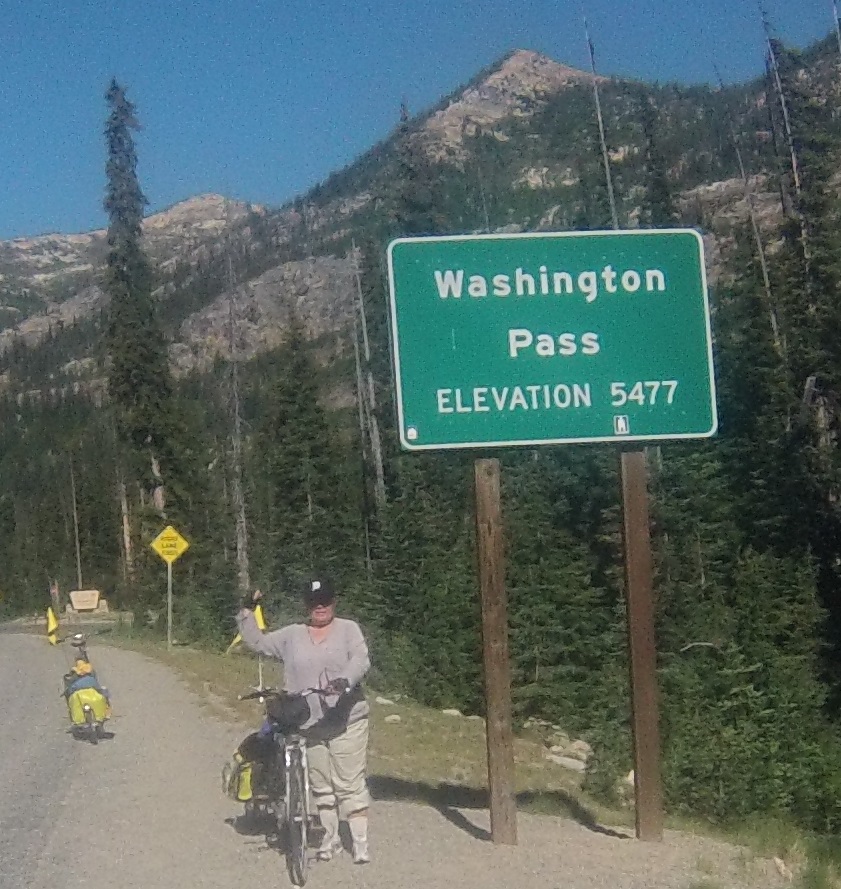
at our wits’ and bodies’ limit, when we finally reach the Rainy Pass summit. To our great relief, we see a picnic grounds. It is neglected and the water taps don’t work,
to our great surprise. We are grateful
we still have spring water gathered from the mountains. Our tap water from the campground was long
gone. Wild gathered water is always a
risk, but dehydration is a bigger and more immanent threat.
We eat a meager, but delicious, dinner in a pestilence of
mosquitoes and biting flies, and look where to make our illegal camp. The tent, somewhat hidden on the edges of the
picnic ground, is a blessed relief after the rigors of the day and frustration
of mosquitoes in our eyes, ears, and everywhere. We had come 29 miles, all of it up hill, and
much of it walked. We sleep almost
immediately.
The ride down is something else. It is a straight shot down the mountain: 16
miles. We have to pull our bikes to a stop
every so often because our hands have gone numb from the shaking and braking. Wes
and I agree, during one stop, that it would be terrible to have to go up
this steep hill. At one point, I note that it is a good thing I have brought the speed down to a more
reasonable level, and when I check it, I am still going close to 27 miles an
hour.
We have already decided we are going to take a room when we
get to the bottom. I saw Freestone Inn
and Cabins on the map and said, “Let’s try there.” When we pull in, we see it is a lovely resort
next to the Early Winters stream.
We get a cabin next to the creek, wash ourselves, and
happily drink a cold beer. We wash our
stinky bike clothes in the sink and put them out in the hot, dry air. (I’m sure
our neighbors like the look of clothes strung on the porch of our
cabin). We enjoy a wonderful meal and
visit at length with the other guests.
It is really nice, especially remembering that just twenty four hours
earlier, we were lurking in an illegal camp with no food or water, after a long
brutal day.
We still have no phone service, but the inn has Wi-Fi, so I
am able to get email. The services for
Judy will be in Riverton, Wyoming on Saturday, July 27, 2103 at 9 am. There is no way for us to get there.
We wonder about the curious ways we make it through our lives. There are no promises. Whether our lives stretch through years and
years, and slowly wind down, like Rose’s, or blink out in an instant in a
bizarre accident like Judy’s; whether we rush toward them in great hope and
expectation, or slog our way through duties and obligations, it still is just
as Samuel Beckett said, “The light gleams for an instant, then it’s darkness
once more.”
Subscribe to:
Posts (Atom)