Total Pageviews

Showing posts with label landscape. Show all posts

Monday, October 28, 2013

T+125: Fellow Travelers, Pt. 2


Des Moines, Iowa: On June 23, Wes and I stayed at this same Candlewood Suites, en route to Wyoming, where we would pick up Wes’ bike and make our way to Portland, Oregon.  It is now October 25, and we are making our way back to Wyoming, to drop off the bike and finish writing the story of our travels from Portland to Portland.  In many ways, the trip began on that night in June, when we watched the movie, The Journey, with Martin Sheen.  That movie resonated throughout our trip….the times of just going, the moments of grief or of jubilation, the tender and touching connections with people who walked…or in this case, cycled…into our lives, and left such a big impression.
 

We had just got on the Erie/Niagara Trail and were making our way along the eastern coast.  Our goal was Niagara Falls, but it was far and we were tired.  We couldn’t find one nice thing to say to each other.  All the petty grievances of constant companionship were at the front of our minds and quick off our lips that day.  Why can’t Wes eat one meal without spilling food on himself?  Why does Shaun always dawdle and delay and mess around when we need to be going? 

About five miles in, a youngish man, full beard, chestnut colored hair, riding a bike with full panniers, rides up alongside us.  One of his panniers is a rectangular plastic box. Normally, one buys kitty litter or soap in these containers.  Here it was bolted to his bike rack.   Seeing that he was a fellow traveler, I launched into the regular litany of questions.  Where are you coming from?  Portland, where he lives.  Where are you going to?  Rhode Island, to meet his girlfriend, although his original destination was Portland, Maine.   He and a group of 4 other bicyclists set out the third week of July and have been pretty much following the Northern Tier.  However, the group has been splitting apart.   Two split off in Montana, including the girlfriend he was rushing to meet in Rhode Island on October 8.  The other two he left in Minnesota.  He has been traveling alone for a while now.  After experiencing what Wes describes as “Existential Angst” (Why am I here?  What am I doing?)  during a particularly difficult crossing of Michigan, he has chat stored up and is anxious to talk.

And talk we do.  His name is Bruce.  He is originally from New York, but has been living in Portland for some years.  He is an emergency room nurse by trade, but a mountain climber/adventurer by avocation.  This is the first time he has taken a major bike trip.  He has been camping and eating rough most of the way.   A light day for him is 70 miles.  It is clear that he has slowed down to ride with us; Wes and I are pumping as fast as we can to keep up with this slender, strong man and his light, modern bike. 

We talk of our trips and compare notes.  Bruce is a mountain climber and backpacker.  He has been on many trips, but even he found the ride over the Cascades a challenge.  He was eaten alive by mosquitoes in Saco, MT.  They stayed on the freeway all the way across North Dakota, never venturing into the back ways and farm routes we explored.  He left his friends in Minnesota so that he could make time across the mid-section.  By the time he got to Wisconsin and was going to take the ferry at Manitowoc, it had broken down.  It was not at all clear who or how or what was going to be able to fix that 100 year old coal fired ship.  (I wonder what has happened to family associated with Two Guys taxi; ferry traffic was the mainstay of their business).  He took the hovercraft over the lake, landing at Muskegon.  He wandered through busy roads and surly people in our home state and was glad to be out of there.

He was bee-lining across Canada and anxious to get to Niagara.  Despite having been raised in New York City, and having travelled extensively throughout the state, he had never seen the falls.  After that, he was off to the Finger Lakes, Ithaca and Cornell, then lickety-split across the Catskills to Rhode Island.  He had a ride of about 700 miles to do in 8 days.   Of course, this makes Wes and I feel like a couple of pikers.

After we wore out the topic of our trips, we soon turned our attention to politics, the economy, our personal history…and more.  The conversation continued apace as we rode the fifty miles to Niagara Falls.  It continued as we explored the town and ate dinner together that night.  It didn’t stop until we said our good byes the next morning from the hostel in Niagara Falls.

Like us, Bruce was using the bike trip to sort out a life change.  He had been an emergency room nurse for some years and had been satisfied with it.  He had recently purchased a house in Portland, and now at the age of 40 (he looked barely 30), his life of work interspersed with adventure was no longer working for him. He had become frustrated and disaffected with the branch of medicine in which he was working.  When he was younger, he had liked the adrenalin rush and lack of relationship at the core of that type of nursing.  It wore on him now.

I told him that my sister was a nurse and that she has found a great deal of satisfaction, after years of bouncing around the profession, working as a hospice care nurse.  She really enjoys that it is patient and family-centered.  Bruce says he has thought about it and is going to think some more about it.  This conversation occurs as we are on the most eastern reach of Erie, as we are cruising past giant houses on the Niagara Recreation Trail, 40 miles into our common ride.

Bruce is a generation younger than us.  His view of his prospects and future within the American economy is sobering.  He has an enormous student debt that he believes he will never be able to pay off.   He feels good about the house he recently purchased, but allows that he is the only one of his friends to make that commitment.  He has no pension plan, no retirement savings, nor any expectation to ever receive Social Security.  He feels his best strategy is to make the most of each day, no promises given nor expected.  He doesn’t perceive a social contract beyond his circle of friends and family.

We are surprised by this.  He allows that it would be a good thing to feel as though one were getting and giving in a web of mutual support.  It’s just that he has never seen or felt such a thing.  He is not a member of a union, and doesn’t think he knows anyone who is. 

It would be tempting to say that Bruce is alienated, but he is not.  He is a free agent, and ok with that.  He benefits from white privilege and knows it.  We all know that we move more freely than any person of color.  A case in point: the night before Bruce camped (illegally) in the closed Peacock Point Provincial Park.  Local law enforcement saw him there and shined a light on him, then moved on without saying a word.  Would that have happened to someone who was not a white male on a nice bike?   It is not hard to think of scenario where the answer would be “No.”

He is an alert, educated, compassionate guy.  He lives simply and tries to pay attention to his choices.  Part of the reason he has the plastic box pannier is a commitment to living without waste.  What surprises us, over and over, is the lack of collective conscience or experience.  He was self-centered, but not at all narcissistic.  Being for himself and himself alone was not driven by ego; it was the way he was trained to be.  It was how society asked him to perform.

He was truly surprised when I told him about our life in Detroit and that I know at least 100 people by name in my immediate neighborhood.  Detroit is incredibly rich in social capital, I tell him.  The kind of art-making, storytelling, urban agriculture, mutual protection, and social activism that makes up our daily life in Detroit sounds appealing, but utterly foreign, to Bruce.  I do understand that social capital is required and present when financial capital is absent, (otherwise known as “making a way out of no way”). In addition, it is easy to disengage from the social contract when one has financial means.  What bothers me, truly saddens me, is understanding that there are a large number of young people who don’t see themselves connected to any larger whole. 

As we get closer to the falls, all three of us get more and more excited.  This is a momentous point in our trip.  Already we are seeing all sorts of signs of this area’s pre-American Revolution past.  When we cross the border tomorrow, we will enter one of the original colonies.  We are amazed at how little we know of War of 1812, which is remembered and celebrated all throughout this region.  I say to Wes, “Just think! When we cross the border, we will actually be in the Atlantic United States.”  (I will soon discover the folly of that statement.)  We stop to take pictures of the corner of Lake Erie with Buffalo, New York in the distance.

We bike along the edge of the Niagara River.  The river is big and powerful, with enormous rocks which generate ferocious rapids.  It is easy to see why this river created such a barrier.   When we get to the town of Niagara Falls, we find ourselves in a huge sea of humanity, even though this is mid-September. It is impossible to cycle in this throng, so we dismount and pick our way through the crush.  

The range of people here is astonishing.  There are women in gorgeous saris, groups speaking in the clicking tones of very South Africa, many, many Asians, some speaking Japanese, some Tagalog, maybe some Vietnamese, Korean, and Chinese as well.  There urban folks and country folks, the tight pant set right next to the baggy pants brigade.  There are busloads of seniors, mamas attempting to corral little ones while pushing strollers.   Young lovers kiss in front of the falls while someone takes their pictures.  There are folks in wheelchairs; people conversing in sign.  I saw one family pushing what looked like a gurney with a person tightly wrapped in a handmade quilt toward the guardrail.  A woman, whom I took to be the grandma, held the wrapped one’s hand and issued a running commentary on the sights and sounds.  Every complexion, every size, every age is represented: what a global mosaic.

Everyone takes turn pushing up to the guardrail to take a look at the awesome horseshoe falls.  There is a full 180 rainbow over the falls and a light mist falling over this human sea.  The city stretches behind us with high-rise hotels; helicopters circle endlessly and dip in and out of the water’s mist.   Boat with names like the Maiden of the Mist chug towards the cataract at the base of the falls.   On the edge, at least 300 feet above, we can hear the faint squeal of the crowd on the boat as they move into the fall’s spray.  The whole experience is giddy, surreal, slightly euphoric. 

I need to find the ladies room, so make my way through a cavernous hall, jam-packed with people.  It is tricky and takes quite a while.  While I am gone, a young man with a bike pulling an overloaded BOB trailer introduces himself to Wes.  He is Japanese, quite young, riding a single gear bicycle.  He has just begun his trip and is headed west, on the opposite path we have just traveled.  Wes and Bruce try to get this young man to join us at the hostel for the evening.  However, the wind has shifted and the light mist has become the equivalent of a heavy drizzle.   Just as I return, the young man bows deeply to Wes and Bruce and disappears into the crowd.

It is getting late; we need to get to the hostel and get our dinner. As we ride, we worry about this rider.  How will he ever make it over the Rockies and Cascades with a single gear?  And it is much too late in the year to be staying so far north.  He told Wes he was carrying 35 kilos on his bike…80 pounds and no gears as fall is coming on… with limited English.  Ay, ay, ay….

After we check into the run-down hostel with just a single staff on duty, a jocular, sandy-haired native of Ireland named Eric.  The hostel has all sorts of signs of events and tours it is offering on Fridays.  This Friday, there are none.  Wes and I have (over) paid for a private room; Bruce sleeps in the men’s dorms.  We walk down to Queen Street for dinner.  This area used to be the hipster/bistro/quaint shop district of this tourist town.  Now, most of the shops are closed and our steps echo as we walk.  We go into a brewpub, eat pretty average bar food, and listen to a group of Canadian physicists talk about US and Canadian politics.  Bruce is happy to be sleeping inside and eating at a restaurant.  Both have been rare events on his journey.   We take our leave.  Bruce wants to go listen to some incredibly loud rock music (we heard it three blocks away) and sample the local beer. 

Wes and I are very much aware of our age as we say good night. The 70 mile ride with Bruce has pushed us pretty hard; we’re beat.  Wes is complaining of a scratchy throat and watery eyes.  He thinks he might have picked up a germ while we traversing the crowd.   We wonder at Bruce’s endurance, although we do remember our last bike journey from Montreal to Halifax and back to Quebec.  We camped and cooked our own food the whole way.  Such are the strengths and fleeting ways of youth.

The next morning, we are off on our bikes before Bruce, although we are sure he will overtake us and leave us behind.  We stop and ogle the whirlpool vista, where the river makes sharp turn.  At another vista stop, we mis-communicate and run into each other, wrecking both of us and causing a group of seniors who just exited a bus to come running over to see if we are all right.  We are a bit battered, but more embarrassed than anything.  The bruise on my knee and gash on Wes’ finger will take the rest of the trip to heal.

Crossing the border is hectic. We are the only bicyclists in a swarm of motor vehicles.  We wait behind a group of motor cyclists from New Jersey, who have been out on a 1000 mile weekend jaunt.  They will ride 350 miles back home today.  One of them is long-haired, good looking, perhaps Tongan, and he is fascinated by our trip, but wants to know why we haven’t used it to raise money for a good cause.  He didn’t like our answer that we were using it to make a change in ourselves.  As he rode off, he said, “Next time you do this, make sure you benefit someone else!”

With that, we enter the last phase of this trip.  We are tired, but think we are almost done.  We are wrong.  There are many more challenges, some of them as hard as any we’ve faced, in the last days of this journey from sea to sea.
 

Posted from Centennial, Wyoming

Saturday, September 7, 2013

T+71: Dash across North Dakota, Part 1


Mile 2180: MOORHEAD, MN

After the difficulties, delays, and delights at the borderlands between Montana and North Dakota, both Wes and I are worried about time slipping by.   We plan to leave our lovely room in Medora around 6 am.  We climb out of the bottom of the badlands and travel about 12 miles to the incredible view at the Painted Desert viewpoint, when we hear a beep.beep.beeping of a car.  We turn to look and it is Terrie and Ricki, our original benefactors, coming to say goodbye and wish us well.  We exchange numbers and emails and hugs.  They drive off and we press on.

The route has us riding Interstate 94, which is both fast and kind of hateful.  The shoulder is very wide, but there is lots of debris. It is amazing what we see along the sides of the road.  More cans and bottles that you can imagine.  All manner of dead animals, especially deer, raccoons, and countless birds.  I have been keeping count of the number of single shoes I see: 38 thus far.  As we pass the fields of corn, soybeans, and wheat, we are also crossing fields of grasshoppers.  Some seem suicidal, jumping into our rolling wheels.  We note that grasshoppers are cannibals and can be seen eating the carcasses of their brethren.  There are clothes, and bags, and innumerable cell phone bits.

At Dickinson, ND, a rapidly growing boomtown with a giant plastic land on its outskirts, we hang out in various fast food joints while we wait for the temperature to drop below 90 degrees.  We agonize whether to stay on the interstate or take the route through the farmland.   At around 5pm, with temperature still over 90 degrees, we come to a crossroads.  Do we stay on the somewhat hateful but fast interstate, or do take the scenic backroads which are more beautiful and interesting, but much more difficult.   As the founders of a theatre dedicated to the creation of new work, which do you think we take?  The unofficial motto of Matrix Theatre Company, as we jokingly say, is  “We do it the hard way.”  You know we took the scenic route, though we were tempted by the fast and ugly route.

We head out, over hill and dale.  It is Sunday, and we did not pick up any food in Dickinson, assuming we can stop in the little town of Taylor when we get there.  By the time we are ten miles out of Taylor, we are out of energy.  We count the miles to the little town. When we get the town itself, everything is closed.  It is still another 15 miles to the next stop, where we plan to stay.  Running on empty is a damn good way to lose weight.   As we approach the little town of Richardton, we see for miles a beautiful double spired granite church building.  It is a Benedictine Abbey, tall and elegant against the evening sky.  It seems out of place in this land of corn and sunflowers.  We find out later, much later, that the Abbey takes guests.  (We are jealous when we hear this.) We get to Richardton on a wing and prayer and pull into the only thing open in town: the local tavern.  The only food is frozen pizza, which tastes damn fine at this point in the game.

When we pull up to our motel, we are happy to note that it is next door to the Hamburger Butcher Shop.  It is not what you think.  The name of the family is Hamburger.  We were lucky enough to have dinner with them in a crowded restaurant back in Medora.  This was three generations of a family who described themselves as German Russians.  The wife’s family name was Gaab and they come from land now considered part of the Ukraine.  Apparently, this part of North Dakota attracted many people from that part of the world.  There are four people in this group, mother, daughter and husband, and their son, Truman Hamburger.  Truman is all of 9 years old, bright and verbal well beyond his years.  He tells us of his entomology classes and his day being a bat boy for the Minnesota Twins.  He is fascinated by our trip and asks more questions than his parents and grandmother would like. 

Right after we make our payment, we open the door and there is Truman. He saw us ride by and came running out to greet us.  He runs back to tell his parents, who stop by and who treat us to coffee the next morning.  As luck would have it, both times the Hamburgers come to visit, I am in the processing of changing clothes.  Wes has to do all the relationship building.  We exchange emails and promise to be Truman’s pen pal. 

After Richardton, we cycle through ups and downs, mostly facing a pretty stiff wind.  We see an outcropping of phragmites near a railroad crossing, the first view of this invasive species we have seen since leaving Michigan.  At the next restaurant, we warn the locals about this bane of a giant reed, but they don’t have the slightest idea what we are talking about.  I still feel I should write the North Dakota Department of Environment.

When we cross the freeway, both Wes and I decide we have had it, and that expeditious and easy has its purposes.  The ride on interstate 94 is tedious and noisy.  However, the long hills are moderated and evened out for truck traffic.  North Dakota is an ocean frozen in time.  The waves rise to the west in north/south undulations.  We pull up a big hill, scoot down the other side, over and over. 

It starts to rain.  Interstate bicycle riding is even less pleasant when being splashed by giant eighteen wheelers.  We are very happy to stop at New Salem, where the most remarkable feature is a 30 foot tall plastic dairy cow on a bluff.  The room is great; we have a nice visit with touring motorcyclists.

The next day is an epic run through deep valleys in sharper and sharper undulations as we enter the Missouri River valley.   The river is massive at this point.   The bike route takes us through a series of parks, golf courses, and wetlands.  We are so happy to be in shade, real shade from real trees, the first in many, many miles. 
 We have ridden 40 miles before breakfast (truly lunch by that point), so we decide to stay, despite the relatively short distance covered. We need to do some re-supplying.  We visit the local mall (a complete shock); I get new shoes.  We get a room at one of Bismarck’s landmark motels, The Ramkota.   This is a big fancy motel, circa 1968.  We enjoyed our stay immensely and wondered if it was being outcompeted by the plastic-land motels and suites that have grown up around it.

The next day is one of the most difficult of the bicycle trip.  It is HOT.   We leave Bismarck early and have fun for the first few hours.  The landscape is challenging and there are few services.  There will not be a place to get anything until the little town of Hazelton, some 45 miles from Bismarck.  When we turn on to highway 89, also known as the Lawrence Welk highway, the sun is blazing, we have drunk most of our water and we still have 12 miles to go. We going south, facing directly into the sun and hot wind. I can barely go and Wes is getting further and further ahead of me.  At one point, he looks back and cannot even see me.  He circles back to see me struggling along the highway, plugging away, but moving slowly.  It is tough going, but what is the choice?  All we can do is plug away. 

We have dreams of a sandwich and cold drink dancing in our heads.  We make it to town completely beat and find out Little’s Joe restaurant is closed.  At the grocery store, we drink several juices and eat ice cream and are thrilled to find out they make smoothies. (They make the best orange crème smoothies in the world.)  All sorts of people come over and check on us.  They ask about our trip, but really, I think they are worried about the two red-faced and sweaty bicyclists in their midst.

I am done in.  I feel dizzy and need to lay down. I go outside to rest on a bench.  A paunchy fellow with shorts pulled up well over his capacious belly comes and sits by me.  He is a retired earth science teacher.  He tells us that North Dakota is quite anomalous, both geographically and hydrologically.  For one thing, much of this state’s water drains, not to the Mississippi, but to Hudson Bay.  When we leave the high perch that is Hazelton, we leave the Missouri River drainage.  We will come across an ever increasing number of ponds, pools, and small lakes, many of which are not fed by surface water.  In fact, Devil’s Lake, in north central North Dakota, is completely fed by underground waters and even so, has risen several feet in the past few years.  The town is now below the surface of the lake, which is held back by dykes.   North Dakota, by rainfall alone, should be a desert, unable to grow wheat, much less corn and soybeans.  However, it sits on a layer of clay which holds the water and which is fed by underground waters.  This is what makes the miles and miles of cropland possible…and why North Dakota is so much more lush and green than South Dakota.

He tells us that the Bakken Field, the source of the huge boom on the west side of the state, has enough oil for 75 years and when that is done, they have discovered another pool of oil beneath that one.  He has no patience for wind or solar energy.   When we point out that this would be prime territory for both, he laughs and asks, “And what good would that do me in the middle of winter, eh?  Without batteries, the whole thing won’t work.”  About that time, an elderly neighbor interrupts our conversation and requests his assistance to back up her car.  Even though we have learned a lot, we are relieved when he goes to help her.

To Be Continued…
 
Posted from Milaca, MN

Sunday, September 1, 2013

T+65: Good Looking, Get Along People

Mile 1887. NEW SALEM, ND

The tale of our travels on the Hi-Line continues….

Our next stop is a little town called Saco, which everyone has warned us has the world’s worst mosquitos.  It is sitting on the clay basin of a former lake, which is flood irrigated with the waters of the Milk River.  This means that there are lots of places for water to sit and mosquitos to breed.  All throughout the hot ride to this town, I have been feeling nauseous.  I think it is an after effect of yesterday’s dehydration, so plug on.  Saco is a hot, dusty town of about 125 people.  Like so many of these Hi-Line towns, it has an abundance of 1910 buildings, empty and slowly decaying, reflecting the much higher population that lived here 100 years ago.  Most of these towns emptied out during dust bowl days, never regaining population or services.
There is one beat-up motel and a café, which is closed for repairs.  We drink a beer in the wonderful old bar while waiting for the motel owner to come in from the fields and rent us a room.  While there, we hear the first inkling of the transformation and tragedy that the boom on the Bakken Oil Field is bringing to eastern Montana and western North Dakota.  A young woman, celebrating her 30th birthday, is talking loudly, ostensibly to the sympathetic female bartender, but also for everyone else to hear.  She has been working in the oil patch, making good money, but her three kids are living with various dads and grandmas.  She has not seen them in weeks.  She tells a horrifying story of the death of her young daughter last year.  The little girl was run over by her father, with whom she was already not speaking.   She circles back to the fight at the funeral over and over.   At least five times she says she is doing great, making $18/hr plus overtime.  She and her current partner, pick up two six packs every night just for the ride back home from the oil patch.  We get the heeby-jeebies at all of this.

The temperature is nearly 98 when the motel owner returns.  Camping is out of the question, so we take the pretty awful room.  This is definitely a room where we do not want to sleep in the bed, so we get our camping blankets out, and sleep on, not in the bed.  The little store in the town has a very small selection, so we make some frozen chicken strips (yuck) and a salad.
The next day, we are up early.  The sky is low, grey, and threatening.  I don’t feel well at all.  We want to get out of this town, so we decide to leave despite the skies.  Of course, about  2 miles out of town, as we cycle into a howling wind (which still does not deter these damned determined Saco mosquitos, who bite us while we are cycling), the rain begins to pelt.  It is 15 miles to the next town and there is nothing we can do.  We push on, miserable.

The only services in this little town is a convenience store, which we are glad to pop into.  The four guys sitting around a table, laughing and telling stories, look up as the bedraggled cyclists come in.  Wes goes over to get some hot coffee.  When he looks down at me, he exclaims, “Are you all right?”  I am not all right.  I am ill.  I have fever and chills; my stomach is upset.  I am shaking.  We drink coffee and look at the pouring rain.  I feel worse and worse. 
When the coffee klatch breaks up, I ask, “Are any of you going to Glasgow?  Could we pay you to give us a ride there.  I’m ill”  Wes looks shocked that I would take such a step, but one of the fellows says he driving back there, and sure, come on.  We load the bikes and BOBs in his pickup.  I climb in the back seat. Wes clambers in the front.  While I grow increasingly woozy, they visit about all manner of things. 

Dean works for the BLM as an engineer and knows the land around here very well.  He explains that this whole Milk River valley used to be the course of the Missouri River until an ice dam changed its course.  He talks to Wes about the economics of farming and tells us that is not such a risky venture these days, because farmers have federally subsidized crop insurance.  No matter what happens with their harvest, they will get paid.  He also tells a joke that Wes has delighted repeating. “How did the farmer double his income?  Answer: He put up another mail box.”  In other words, he established two businesses where there had been one and got two checks from the government.  This is also known as “farming the government.”
Dean drives us directly to the Cottonwood Inn. He refuses any offer of pay for the ride. It is beautiful and modern and well equipped.  I am not afraid of the bed here.  I go directly to it and sleep for two hours, then get up and have terrible digestive disorders.  As Wes and I talk it over, it seems to us that I have either picked up a mild case of West Nile virus from the mosquitos, or more likely, a bit of food poisoning from the undercooked sausage.  In between bouts, we wash clothes and get organized.

The next morning, I feel better, although still a little gurgly.  There is a sharp breeze blowing from the west (the long awaited tail wind!) We are back on Highway 2 and zooming along.  We stop at Elsie’s Café, and it is clear that this is quite the community gathering spot.  The waiter/co-owner is a former teacher.  He says, “My principal used to tell me what to do.  Now I just do what my wife tells me.”  She groans, “Oh, Arnie!” from the kitchen.   Little boys come in; old men speak to them by name and ask them about school starting.  Teenage girls come in and ask for ice cream for a party they are giving.   All across the dining people are chatting with each other, and with us.  The food is good and the energy is wonderful.  We don’t want to leave, but we must.
The heat starts to rise as we pedal on.  We are moving fast with the wind at our back, but getting hot.  We are now on the Fort Peck reservation.  We go into the Nakota Store and arrive at the exact moment the owners do.  The father and son duo make us smile.  The teenager has probably been awake about fifteen minutes.  He has thrown on the most comfortable, pajama like shorts and slides he can find.  He is exceptionally handsome, with a big broad smile, but pretty mumbled and unclear answers.  His father is wiry and energetic.  We buy two drinks each and stay in the cool to drink them.  The owner’s name is Tom Fire Moon, and he has managed stores all over: in the Navy, in San Diego, for Walmart, back and forth between Poplar, MT and California.  We find out he was on the same aircraft carrier as our brothers.  He tells us that his daughter was runner-up for Miss Montana, and that she won the talent competition singing a song from Les Miserables.  Tom tells us that they are Assiniboine and wants to make sure we know that Assiniboine are not Souix, with whom they share the reservation.   He makes us laugh, over and over, as we visit.  One time: we note that the calendar on his wall has a big picture of Mount Moran on it.  We say, “That’s where Wes was raised.”  Tom goes up to it, peers at it very closely, and pronounces, “Oh, I can see your house right there.”

All the while, various folks are coming in and out.  Some are getting gas.  One fellow says, “I’ll get some gas now, and when I get my check, I’ll bring you the money.”  No problem.  Another asks about our route.  He says, “You should take Indian Road #1.”He takes me to the window and shows me how to get on it.  “You’ll like it a lot more than Highway 2: no trucks, no traffic, much better scenery.”   Both he and Tom warn us about the upcoming dangers as we get closer and closer to the boom in Williston, ND.  This has now become a trope.
We take that route and he was right.  With the big tail wind, we careen down the highway, through little towns and big fields.  It is really fun and we travel the remaining 30 miles of that day in a flash. 

Wolf Point, MT is an odd town.  Full of oil traffic, yet also showing lots of signs of alcohol and meth problems, it has several banks, but no independent cafes that we can find.  We get the last room in the Sherman Inn.  It is full of oil patch workers and there are signs in the room about not using the washcloths to clean off grease.  The restaurant and bar are full of men of all ages and a variety of races.  This is not Elsie’s Café.  No one looks at or speaks beyond their table.
The next day, we leave the Hi-Line and begin our journey to the middle of North Dakota.  We cross the Missouri and have a long, arduous cross of the divide between the Missouri and Yellowstone River valleys.  There will be no services for 50 miles, just plenty of hills, miles of wheat, and a pretty stout side wind.

About half way, we stop in the shade of tree in front of the post office in Vida (no services, population 25).  We are drinking our water and about to eat our apple, when the postmaster comes out and says, “Come on in out of that heat.  You can sit here and drink some of this water right here.”
Her name is Lynette and she is the fill-in postmistress.  A former retail manager, she has taken this job in her retirement and has had postings all over this country.  Vida is a half-day post office and she will have to drive 60 miles to another post office on the Canadian border later today.  She spends the whole time cleaning the ornate oak panels of this post office while we visit.  We mention how friendly we have found people and what a hoot our visit at the Nakota store had been and she says, “I know Tom Fire Moon.  I used to run that store myself.  Did you know his daughter almost became Miss Montana.”   As in turns out, Lynette is also a member of the Assiniboine tribe.  When we say, we have heard much about that tribe, she laughs and says, “That’s because we are called the Good-looking, Get-along people.”  It certainly true in her case, with her long dark brown hair, golden skin, and blue eyes, and her busy, jokey and story-telling energy.  

It is hard to leave, but we must.  We thank her for her hospitality.  On the way to Circle, we think that is not just the Assiniboine who are get-along people and we wonder if it is the landscape or the culture or the economy….or all of the above… that have made folks so open, curious, and engaging.  We don’t know, but we sure do like it.

As we go down to Circle and enter the shadow of Williston, we face a lot of difficulties and see a lot of damage being done, but are we are astounded by incredible acts of grace…but that is story for another day….

 
Posted from Moorhead, MN


Wednesday, August 21, 2013

T+56: Harvest on the Hi-Line, Part 1

Mile 1523, SACO, MT

We have been traveling along US Highway 2 since leaving East Glacier.  It is commonly called the Hi-line, as is it the most northern national highway.  It has been quite an interesting experience, with plenty of surprises, and a new slice of American culture for us.

Our first stop after East Glacier was Browning, MT.  We had visited Browning in the early 90’s and were shocked by the poverty and abandonment at this Blackfeet tribal headquarters.  We had been concerned about it and organized our current route so as not to spend the night there.  Boy, were we wrong.   First of all, the town is about 3 times bigger than it was 20 years ago.  There is a big casino, a big museum of tribal culture.  There are many new businesses, including some sort of heavy equipment supplier on the south side of town.  The beat-up little “agency” houses, that dominated the town 20 years ago were nowhere to be seen in the Browning of 2013.  We had a nice breakfast and were waited on by a group of teenagers who looked up from their I-phones when we came in, then couldn’t believe we were from Detroit and traveling Montana by bike.  It was lovely…a good surprise.

We ride for miles through the Blackfeet reservation, seeing so many birds of prey and hundreds of horses…certainly more horses than we have seen anywhere else.  We plug along, committed to making 50 mile days in this part of the country.  The country is high and dry.  We are looking forward to Cutbank, which we envision as a river town.  As we get close, we go down a big hill, cross a desert river with high arroyo banks, then have to climb 300 feet in less than a mile to get to the town up on the bluff.  The riverside camping we had been anticipating should have been named Cliffside Camping: no trees, in the gravel, on a cliff 100 feet above the desert stream.  We end up staying at the Super 8…and it was great.  We walk over to the little mall and get a smoothie.  The mall is full of families doing “Back to School” shopping.  The people there are a mix of European- and Native- Americans.  There is a lot of teasing and laughing.  It seems pretty comfortable and easy.

After Cutbank, we enter the never-ending wheat fields of the Marias plateau.  All along the highway, we are passed by huge harvesting equipment.  There are massive cutters, and threshers, and giant vacuums.   In one field, we count 2 belly dump semi-trucks, two sixteen wheel trucks, a thresher whose arms extended at least 20 feet on each side, and three other huge pieces of machinery.   We could not even imagine how many hundreds of thousands of dollars all this equipment cost. 

We had hoped to make it to Chester, MT (pop. 847) that day, but by the time we had gone 50 miles, we were out of water, out of energy, and hot.  Our map told of a little motel in a Galada, MT (pop. 50).  We found the motel; it looked closed, but did have a working pop machine.  We only had enough change for one drink.  There was an equipment service shop/gas station next to it.  Maybe they could give change for a five dollar bill.  The operator was on the phone and stayed on the phone the whole time we were there. 
The store had a bit of junk food, some drinks, and a scad of magazines thrown about a big messy table.  While the operator still talked on the phone, another man comes in, sees us waiting for service, and asks if we need a place to stay that night.  We mumble something about making it to Chester, but we were pretty tired already.  He says, “You have come to the right spot!  I own the motel next door.  Let me call the wife and she can come get you set up.” 

We decide, “what the hell?” While we’re waiting for the wife, we find out we can buy a frozen Schwan’s pizza from the guy on the phone.   After about 15 minutes, the wife comes in, flustered as she had been called in from the field where she was working on the harvesting crew.  She shows us the first room, all the while apologizing, saying that the phone was off because they had been working on the road and she hadn’t had hardly any business this summer.  The first room smelt kind of musty, so she opened the second door in the motel of 9 units.  It was like visiting an apartment from 1962.  It had two bedrooms with wooden western furniture, televisions with rabbit ears antennas and a small kitchen with a tiny stove, formica table, and vinyl chairs.  We loved it.

I went to turn on the water.  Nothing.  I tell the wife, who calls her husband, who calls his son, all of whom now have left the fields to come deal with “this motel mess”.  There is a big ruckus while they figure out what happened to the 9000 gallons in the cistern, which is completely dry.  The pump is on and very close to burning out.  It takes another 30 minutes during which Wes and I snooze on the bed.  We still have not registered; we have no idea what the price will be.  Finally, they get the pump primed, and a hose from the well re-filling the cistern.  I turn on the water.  After spurting and spitting, it comes out…brown.  The wife apologizes again, and goes to get us some bottle water to drink.

As it turns out, the wife is a school teacher.   The motel is definitely a side business for this wheat farmer/equipment supplier/teacher family.  It sounds like she has not had guests in this motel since early July.  She says, “I know it had water two weeks ago ‘cause the grandkids used the toilet.”   Finally, all the systems are working again.  She apologizes again for the delays and confusion.  She and Wes get into teacher talk.  At the end of all that, they decide to charge us $25 for the room. 
They all disappear, presumably back to the fields.  Wes and I are alone in the motel.   There is no phone; the TV picks up two channels, the water is not safe for drinking, and we have a really great night.  We sit in the little kitchen and talk about my dad.  He would have loved this little motel and we could easily imagine him sitting at this little table drinking coffee.
The next morning, over hill and dale, still surrounded by miles and miles of wheat, we make it to the little town on  Chester.  The landscape is so undulating, that we can see the water tower for the town sporadically for 8 miles.
Chester is the prototypical Hi-Line town.  Dominated by its grain elevator and train tracks, a small cluster of  businesses cluster around these two central features.   We find Spud's  Café and when we look into the window, it feels like we are entering  a photograph.  There is one young blonde waitress standing at the counter, leaning over, reading the  paper.  There is one customer, sitting alone at a table. 
As it turns out, he is a bit of a character.  He engages us immediately, asking us about our trip and telling us about the area.  His hair is faded red, and cut into an epic mullet.  The front hair is curly and somewhat spikey; the back hangs down past his shoulders.  He is on oxygen and is quite frail, with remarkably loose skin, and knobby knees poking out of his hanging shorts.  He looks like someone who lost much of his body weight very rapidly.  He says, while pulling on his oxygen tube, "Guess I won't be cycling too far anywhere soon."  He also tells us how to tell the hard winter wheat from the spring wheat---the hard winter wheat is more red and grows more in the valleys.  The farmers are cutting it and will turn over the ground to start the next crop.  The spring wheat is still green and won't cut for a few more days.
We are happy to learn this, because we are agog at millions of acres of wheat we are passing.  Both Wes and I thought northern Montana would be more desert-ish.  We are completely wrong.  It is mainstay of the US's breadbasket. 
This fragile gentlemen and the young waitress are the first installment of what will soon be a type...very friendly, curious, and talkative townsfolk.  All along the Hi-line, folks stop us on street, in the grocery store, at cafes, and ask us about our travels.  There are often little self-effacing jokes and always a wish for our safe and enjoyable travels.  


TO BE CONTINUED…

Posted from Circle, MT

Wednesday, July 24, 2013

T+31: Far from Kith and Kin


Entering the Skagit Valley
Mile 574: MAZAMA, WASHINGTON:  The last few days have been a helter-skelter of intense emotions.  The ride from the coast was beautiful and mostly easy, through the incredibly fertile Skagit River bottom, topped by craggy snow covered peaks.  Wes and I are riding easily and feeling a kind of simple joy at the activity and the environment. 

We are in and out of coverage for my phone, and in and out of keeping the electronics charged.  (Keeping things charged while living in a tent requires a variety of strategies with which I am only partially successful.)  All day Saturday, July 20, I think of my mother’s best friend Rose, whose funeral was that day.  I would have liked to be there to honor their friendship of more than 60 years, and to renew and strengthen the bonds of friendship and family that have united the Smith/Strand/Engen families.

Not only did my mother and Rose flee troubled family situations in the South together, travelling and gad-about working in the post WWII era, they came together to the small outback town of Centennial, Wyoming in 1948.  There, new girls in town, they soon met and married the most eligible bachelors in this ranch/logging/skiing outpost.  Best friends married good friends and soon there were babies and challenges and an intertwined life. 
Tragedy struck the Smith family, when my father was killed in a construction accident, leaving my mother with four children under the age of 6.  Without the support of friends like Rose and Bob Engen, it is doubtful we would have made it.   Through the Engens,  my mother connected to their cousin, a shy 39 year old bachelor named Berger Strand, who became my stepfather and dear Daddy. 

Through years of kids growing up both easy and hard, through businesses opening and closing, through divorces of young and old, through shared land, shared houses, and shared education, the ties that connect the Smith/Strand/Engen families are woven still.  I want to make sure those ties live on into the next generation.  But I am thousands of miles away, so all I can do is text my mother when my cell happens to work…and think about the choices each of us make every day. 
 
We have a wonderful camp on the side of the Skagit River, and meet two kids who remind us of ourselves at that age.  They are finishing a bike ride from Minneapolis to Seattle.  They have just finished their degrees.  She has a job on a boat in Seattle before beginning her medical studies; he’s not sure what he’s going to do.  They thought a ride across the country would be a good way to transist from one phase to another.  They are fit and fearless, broke and brave.   They remind us of the hitch-hiking trip we took around the US on our way to my Fulbright Fellowship.  They are up and gone before dawn, zooming off to their new lives, glowing with excitement and promise.


We make our way to the oh-so-plastic general store in the little town of Newhalem where we must make sure we have supplies for the challenge that awaits us.  A bit before Newhalem, we saw a sign, “Last services for
 74 miles.”  Our bike map tells us “Take extra food and water!” We are excited and nervous to begin our foray into the wilds of the North Cascades National Park.   In the store, I plug in my phone and to my great surprise, I have a voicemail from Wes’ brother, from the previous night.

When I check it, he says, “I am sure you have heard the news about Judy, and I just wanted to see what you guys are planning.”  I call back as soon as I can.  We tell him we have heard nothing, and he explains that our sister-in-law, Judy Nethercott, has just been killed in an auto accident.  At the same time, the emails from home, some from two days ago, start to appear on my phone.   I send emails, and texts, as best I can, but hear nothing more.  

Wes and I are stunned.  Judy’s husband Jimmy, Wes’ eldest brother, had just passed about 18 months ago.   The family was still adjusting to that loss.  We worry about their kids, and grieve that their kids will never know their grandparents. 

We stay in the horrible plastic store for as long as we can, waiting for further news that does not come.  When we go out and get on the bikes, we immediately have a small wreck that topples me onto the road, and leaves both of us yelling at each other, inappropriately displacing our emotions.  Just a mile outside of town, I lose all phone service. 
The ride is rough, steep, and in places, quite dangerous.   When we enter a long, unlit tunnel with a steep uphill grade, I scream and hug the walls when cars pass within inches of us pushing our bikes.   We feel the fragility of life. Our emotions are raw. 

At camp, I leave Wes to set up the tent while I get water; I return to him openly weeping.  We don’t know what to do.  We have no phone service.  We don’t know what is going on.  Even if we did, what could we do?  We are in one of the most remote regions we have ever encountered.   The closest airport is probably 120 miles away.  How could we get there?   

We spend a sullen, quiet evening, staring at the beautiful, ice-cold Diablo Lake.  In addition to the strong emotions tied up in these two family deaths, I am also quite concerned about the ride ahead.  When we leave Diablo, it is a climb into the mountains, where there will be no stores, no services, no water stops, and two mountain passes.  There is not even another campground for nearly 40 miles.   

We sleep poorly and get up before dawn, anxious to start this long climb before the heat of the day.   It is a long climb all right, punctuated by incredible vistas and breathtaking beauty.  We push our bikes a lot.  The day stretches on and still we climb.   We can only ride for a few moments, it seems, before we have to stop and catch our breath. 

There are numerous cascades and rivulets pouring down the steep canyon sides.  At one point, we are so hot and tired, we simply go stand in a glacier-fed waterfall, letting the icy water pour through our helmets and down our shirts.

The day goes on and on, and so does the hill.  We have been climbing steadily since leaving Newhalem.  By this point, we cannot ride much, so we must walk.  It gets hotter and hotter.  We now scurry (as much as one can on a steep hill, pushing a bike with 40 lb. trailer) from shadow to shadow. 

Exhaustion fueled irrationality becomes a real presence.  I start making plans to hitch a ride.  How many vehicles can pick up two bikes, two riders, and two trailers?   Wes starts searching in the cliff-sides for a camping spot.  I tell him not to waste his energy, but he insists there must be a camping spot on these 45 degree slopes.

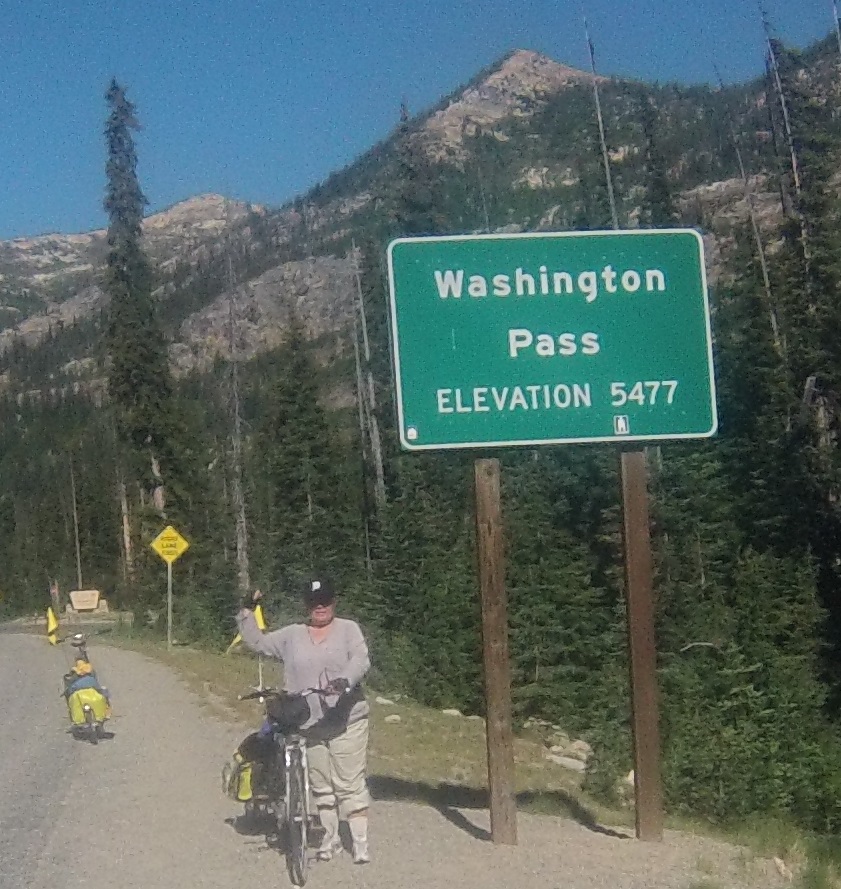
We trudge on.  We are at our wits’ and bodies’ limit, when we finally reach the Rainy Pass summit.  To our great relief, we see a picnic grounds.  It is neglected and the water taps don’t work, to our great surprise.  We are grateful we still have spring water gathered from the mountains.  Our tap water from the campground was long gone.  Wild gathered water is always a risk, but dehydration is a bigger and more immanent threat.

We eat a meager, but delicious, dinner in a pestilence of mosquitoes and biting flies, and look where to make our illegal camp.  The tent, somewhat hidden on the edges of the picnic ground, is a blessed relief after the rigors of the day and frustration of mosquitoes in our eyes, ears, and everywhere.   We had come 29 miles, all of it up hill, and much of it walked.   We sleep almost immediately.

The next day—today—we wake up, eat the last of our supplies, and begin the trudge up the next mountain pass.    It is only 5 miles—a veritable lark after yesterday—and when clear the top, we are astounded.    We are in a cirque of straight walled peaks whose serrated jaggedness is both appalling and wonderful. 

The ride down is something else.  It is a straight shot down the mountain: 16 miles.  We have to pull our bikes to a stop every so often because our hands have gone numb from the shaking and braking. Wes and I agree, during one stop, that it would be terrible to have to go up this steep hill.  At one point, I note that it is a good thing I have brought the speed down to a more reasonable level, and when I check it, I am still going close to 27 miles an hour. 
We have already decided we are going to take a room when we get to the bottom.  I saw Freestone Inn and Cabins on the map and said, “Let’s try there.”  When we pull in, we see it is a lovely resort next to the Early Winters stream.

We get a cabin next to the creek, wash ourselves, and happily drink a cold beer.  We wash our stinky bike clothes in the sink and put them out in the hot, dry air. (I’m sure our neighbors like the look of clothes strung on the porch of our cabin).  We enjoy a wonderful meal and visit at length with the other guests.  It is really nice, especially remembering that just twenty four hours earlier, we were lurking in an illegal camp with no food or water, after a long brutal day.
We still have no phone service, but the inn has Wi-Fi, so I am able to get email.  The services for Judy will be in Riverton, Wyoming on Saturday, July 27, 2103  at 9 am.  There is no way for us to get there. 

We wonder about the curious ways we make it through our lives.  There are no promises.   Whether our lives stretch through years and years, and slowly wind down, like Rose’s, or blink out in an instant in a bizarre accident like Judy’s; whether we rush toward them in great hope and expectation, or slog our way through duties and obligations, it still is just as Samuel Beckett said, “The light gleams for an instant, then it’s darkness once more.”

Monday, June 20, 2011

T-701: Ghost or Live?

In a few short hours, I am going to be leading a sort of Eco-justice tour of Detroit with my friend Rich Feldman. We will be leading teachers and others to some of Detroit's amazing places on both the horrific and the wonderful side.  We will see abandoned factories bigger than some towns in the West.  We will see wonderful productive farms in the middle of the city.  We will see places where the earth is reviving and places where it is screaming.

When we first moved to Detroit, we were very unnerved.  It was so foreign in ways we couldn't understand.  We couldn't understand what we were seeing; we couldn't identify any of the plant life; we couldn't make heads or tales of where we were.  In every other place we have lived, the landscape provided the internal map that told us where we were. 

In the West, the horizon is always present and it took a simple glance to know which way was West or East.   In Laramie, the Snowy Range is to the West.  A hundred times a day, I would look to those granite peaks and ponder the light or the clouds or the approaching thunderstorm.   In Houston, the horizon is defined by the outcrops of buildings, but more important is the crosshatch of bayous which tell you where you live.  We lived just off Chocolate Bayou, and could follow its serpentine mugginess all the way to downtown.

A series of hills and dales defined Reading, England.  In essence, one had to walk downhill to go downtown.  To get the campus, one followed the Kennett River from the Thames River.  In Salt Lake, essentially a big bowl, going down sooner or later led you to the center of town.

This was not the case in Detroit.  Not only did the city not have the mathematical regularity of Salt Lake, where an address of 630 East 800 North told anyone and everyone that you were six and third blocks east and eight blocks north of Temple Square.  Nor did it have the cow path logic of either Rock Springs or Reading, where the roads followed the lay of the land.  In Detroit, there were  grid streets and spoke streets,  curving streets, and freeways, none of which seemed to relate to any specific features of the landscape. 


The Rouge befoe the canal was cut making Zug Island. 
Baby Creek when it was still a navigable stream. 
It is now a concrete tube. 
You can see a remnant in Patton Park.

When we traveled outside the city, which we did and do often, we were struck by the complexity of the landscape in Michigan.  There are lots of hillocks and potholes, creeks, streams, ponds, lakes, swamps, marshes, big lakes and, of course, great lakes.  None of that complexity seemed present in the city.  It itched at me like a mosquito bite.  Where did the water go?  How could all of Michigan all around the city have such a multiplicity of water features and the city have almost none?


That led me to maps first, then historical maps, then 19th century histories, then to various archives where I found out that the land in  Detroit was just as watery and complex as anywhere in Michigan.  There were seven streams in the city which have been largely buried, including one navigable river.  There were multiple wetlands and a few good sized lakes. 
 

Because Detroit grew in spurts, first around the opening of the Erie Canal and second around the auto boom of the 1910's and 20's, its landscape was put to the service of the land speculators without much thought or planning.  That is why to do this day, houses and businesses must run sump pumps day and night.  They are sitting smack in the middle of a wetland.  Detroit regularly gets 30 inches of rain each year.  The water will go where the water will go, house or no house.  Why is anyone surprised when Brownstown floods?  It sat underwater for millenia.  Pushing dirt around doesn't change any that.

So now I am going to lead people around the city and if I do my job right, give them eyes to see where they are.  When they see phragmytes, they should know that there is water within 6 inches of the surface.  When they see certain kinds of poplars, they should know they are near a stream side.  I want to show them where Baby Creek, and May Creek, Parrents  Creeks and Connor Creek are proving that water always wins.  Try to cage them, or cover them or turn them to sewers, they have a way of resurfacing anyway.    I will show them the fifteen manhole covers which mark the confluence of the Savoyard River and the Detroit River.  I want them to see the hill in downtown that shows the course of the river.  I want to help people see the place within in the place.

Phragmites, coal slag, and heavy industry...
this is what Baby Creek has become.
I am glad to do, but I also grieve.  There are places where the earth is screaming with the abuse perpetrated on it.  At the confluence of Baby Creek, the Rouge River, and the Detroit River lies the man made horror of Zug Island.  In another time, it was a rich wetland carved by an oxbow of the Rouge River.  It was not an island at all.  Now it is a toxic wasteland, reeking and repugnant.  It is not alone.   There are so many places where the land has been subject to rape, then abandoned to try and heal itself as best it can.  There are places where it is still being actively abused, as near the steel plants downriver.

It is wearing on the soul to hear the cries of the land.  It is enervating to make my eyes turn away from what was and should be (and can be) one of the planet's most fertile environments.  I do what I can change to help people to see what could and should be, but I have been pumping my aquifer much too long.

I need to hear the earth simply sing.  I need that healing and wholesome voice to remind me of the connection of all things.  I need to hear the voice alive.  The shriveled ghost of a voice of Detroit's earth and water I both honor and share, but I need the roar of the earth alive  to keep the transmission going.   Let the song begin.