Total Pageviews

Showing posts with label family. Show all posts

Friday, October 4, 2013

T+100: A Question of Community


Mile 3580: Brockport, NY

100 days ago, Wes and I drove away from Detroit.  11 days later, we began our bike journey from Portland, Oregon.  It has been an amazing, revelatory experience, but it has been a journey through and with strangers.  That’s what makes the time spent in Manitowac, Wisconsin and Ludington, Michigan so wonderful and so different.   In both places, dear friends came to see us, wish us well, and provide us respite on our journey.  In both experiences, questions of making, participating in, and sustaining community were central.

Robert drove all the way up from Chicago on a few hours sleep to, as he said, “honor and support your trip.”  In 2002, he had taken very nearly the same trip by bike, going from Anacortes, Washington to Portland, Maine pulling a BOB trailer.  He, however, was traveling with a group of 12, with a designated trip leader, and camping almost exclusively.  We spent a fair amount of our too short visit comparing trips---comparing the places and people that somehow touched us.   They were traveling just after 9/11; emotions were still raw.   Robert did not see the signs of economic devastation that we have seen nearly everywhere. 

Also, his group was a company of strangers that came together for a common purpose and experience.   There were big variations in age and outlook in the company composed of 11 men and 1 woman.  It didn’t take long for the group to divide into niches, then cliques, then factions.   Robert ended riding the last part of the trip alone, as each faction broke off and took their own journey.  Ten years later, the group has not stayed in touch with each other.

By contrast, this trip has re-knit my marriage to Wes.  We are with each other 24/7, and lord knows we can get on each other’s nerves.  However, it has re-acquainted both of us with each other’s strengths.  After years of marriage, it is easy to focus the weaknesses, in each other and the relationship.   Of all the gifts of this trip, the renewal of our partnership and friendship may be the most important and enduring.

We also talked about Detroit—how much we love it, what will become of it, and how it is so different from the way it is presented--- and any place else we have ever been.  Robert came to Detroit as a volunteer in service.  That experience began an incredible journey.  After living a year with the Capuchin brothers in Detroit, Robert began the long, arduous path to becoming a Franciscan brother himself.   This is no easy thing.  The whole process takes no less than seven years, which is huge at any point, but gigantic when one begins after the age of 40.   One might excel in the schooling and service, as Robert has done, but finding a way to live in community with other flawed and incomplete humans is challenging under the best of circumstances.  All these contradictions and conundrums were presenting a huge challenge to Robert when we saw him.  All we could do is offer our love and community.  

We could offer no insights on these conundrums, but all of us could be super-fascinated by the process of loading four 80 foot wind turbine propellers onto the Badger ferry.   That was some feat.    It took four semi-trucks and occupied a full deck of the Badger.   Wes and I wondered if they came from the turbine factory just outside of Wausau.

The ride across Lake Michigan on the coal powered ferry Badger was beautiful but boring.  I wasn’t willing to pay the highway robbers’ fee to get Wi-Fi onboard.  It was much too windy to stay on deck, (which I have done of previous crossings).  I didn’t want to play bingo, or watch the movies, or the football game.  Both Wes and I would sit for a while, wander for a while, read the paper for a while.  I was fascinated by the big group of ham radio operators who set up several stations and broadcast throughout the trip.  (In the Colorado floods, the older technologies of ham radio and land line phones were the only communication systems that didn’t fail.)

We visited a bit with a family from Wisconsin, who told us they take a “mini-cruise” every year for the delight of their brother, a vivacious middle-aged man with Downs who LOVED the boat, the views, the food, and was happy to tell his family and those around him how good it all was.  We mentioned that we thought Wisconsinites were not cursed with self-consciousness.   One brother said, “I wish we had more.   All of it can just get to be too much!”

These questions of community were very much present in our reunion with our dear friends Keith and Tada.  They drove over from Detroit, and arranged adjoining rooms for us in Ludington, sweet things that they are.   When the Badger pulled in, amongst hundreds of small boats out salmon fishing, they were dockside, waving and smiling, taking pictures and pointing us out to random passersby.  It was wonderful to see them.  In Ludington, we visited and talked and ate.  True friends that they are, Keith and Tada helped us with our re-supply and maintenance tasks.   It’s a true friend that helps you do your stinky bike laundry.  While Wes and Keith did laundry and talked politics, Tada and I combed second stores looking for fall clothes for our bike trip.

While on these errands, we hear that my brother Steve and his cat had been airlifted from his canyon home in Colorado.  The road is out both above and below his property.  There is no electricity, water, or cell service and will not be for some time.  His wife has arrived from Maine: can they use our car in Wyoming while they secure their property, then drive it out to Maine, where they will stay the winter?  Of course.  It will also work great for us to pick up our car in Maine.  My brother Scott will pick it up in Wyoming and get it to them in Colorado. I am proud of my family. The crisis is now entering what will be a very long recovery phase.  
 

Keith, Tada, Wes, and I also had an extensive conversation about intentional and eco-village communities.  Tada has been fascinated by intentional communities for years and reads extensively about their various iterations.  She is currently focusing on eco-villages.  We talk at length about the various permutations.  Can community be consciously created?  What are the elements of voice and choice, money and power that make or hurt the formation of communities? Humans are weird and capricious, and (like me), so often confused by what we want and what we need.   In my experience, managing the complications of an intimate relationship between two people is hard; I can’t imagine negotiating financial, spiritual, and residential intimacy with a group of people.

The four of us decided to walk out to the Ludington lighthouse under threatening skies.   We stop at the end of the end of the jetty, admire the view, note the many salmon fishers, and have a brief conversation with four men fishing from the pier around the lighthouse.  I tease one fellow, dressed head to toe in camouflage by asking if he was hiding from the fish.  Tada sets down her big daypack while talking to another fellow.  All of a sudden, the wind shifts.  The front, which was headed north, starts coming south.  It is clear we will be rained on in just a few minutes.  We hurry down the jetty and back to the car, but don’t quite make it before the rain begins.  

Back at the motel, Tada realizes she has left her bag.  Keith and Tada return to the jetty under drenching skies to find that all the fishers have moved away from the daypack, to the other side of the lighthouse.  They told them they feared it was a bomb.  They didn’t quite believe it, but were worried enough to move away, just in case.

All these conversations about community make me homesick for Southwest Detroit, which is a real living community.  It is a joy to live where people contribute sports, and arts, and gardening, and history walks, and progressive dinners, and help with building, cleaning, or kids for the good of the community.    How all these communities-- of friends, of family, of location, of choice, or shared experience, or shared values—are sustained and maintained in the face of inevitable human frailty is a big question in all these conversations. 

We don’t have any answers as we climb aboard our bikes after kissing our friends good-bye.   When we head out to the woods of Michigan, we feel quite acutely the loneliness of this kind of travel.  How wonderful it was to be with friends, to share intimate news of our families, to talk at length about our fears and joys.   Travel is fun and meeting people is great, but blessed are those who are held in the web of friendship.  We have been blessed by our friends and we look forward to returning that blessing soon.


Posted from Fulton, NY

Friday, August 16, 2013

T+51: Multi-Bodied Beings

Mile 1264: Cutbank, MT


Judith Snow
The great Judith Snow, a disability activist from Canada, changed my understanding, not only of politics, but of social life as well, when she described herself as a “multi-bodied being.”  She has extremely limited mobility, and requires the use of other bodies—to help her eat and attend to bodily functions, to make her art, and to attend to all the duties and requirements of speaking and advocating internationally.   She points out that we all are multi-bodied beings, but that some people live in a state of grace that allows the essential interpenetration of our lives to be recognized and understood. 
This lesson was remembered in the delightful 24 hour visit we had with my niece, her husband, and their family during our visit in and around Whitefish.  I had not seen Kelsey for a number of years.  Actually, I saw her very little as she was growing up.  My brother (her father) and his family lived in Nevada; we lived in Detroit.   It was hard to make our paths cross with any regularity.  I kept track of her life through the family rumor mill, but I had never met her husband, Justin, and only knew from a distance about their travels to Australia and Argentina.  I had followed on Facebook the progress of her pregnancy and the birth, a few months ago, of their son Jasper.

So we were very pleased to receive a phone call from Kelsey, who had been tipped off by my mother, that we would be in the area.  We met for breakfast, but the visit stretched into the next day and touched me on several levels.  
Babies, of course, are the exemplar multi-bodied beings.  They utterly depend on the actions of others to move them, feed them, and ensure their safety and needs are met.  Kelsey and Justin move in sync in this task, taking turns carrying Jasper on his or her back.  When Kelsey wants to go out into Whitefish Lake to wade and swim with us, Justin stays behind, Jasper in the carrier on his back, while he wades up to his knees in the water, then sways gently as he watches us move into deeper water.   They are a smooth parenting team, getting the diapers, cleaning the baby, toting the inevitable bag of baby paraphernalia.  Both Wes and I remark how different it was in our parents’ and our generation.  Dads were commonly quite distant from moment-by-moment needs of the baby.    Kelsey and Justin very much were Jasper’s extensions into the world—but they were also that for each other.

When we met Justin’s mother, Carolyn, the lesson was brought home in a few more ways.  It was very sweet that Justin and Kelsey offered us a place to stay, to wash our clothes, and generally catch up.   After attending to various chores (getting a brake job on Wes’ bike, buying Wes new shoes, and replacing my worn-out bicycle gloves), Kelsey and Justin pick us up, take us swimming in Whitefish Lake, cook us delicious chicken brats, and then take us to his family home.   
The house is in between Kalispell and Whitefish.  It is a lovely house that the family designed and built in 1988.   Carolyn says, “We had an open plan before it was even called that.”  We are invited to stay in Justin’s boyhood room.  This tickles us to no end, as we look at his award for scholastic achievement at the age of 10, find out that he was a great soccer fan, and see his smiling schoolboy pictures from the age of about 12.  This is truly an unfair advantage for visiting relatives.

We discover two things during this visit that remind us how important we are all to each other.  Carolyn, to our great delight, is the union president of her bargaining unit for the Forest Service employees in the Kalispell region.  What a relief for all us--who normally have to watch what we say in this part of the country-- to talk about the way that his country is set up, more and more, to benefit the few at the expense of the many. (How did we get to the point that expressing any negative analysis of capitalism is seen as dangerous and unacceptable?) 
We talk about the necessity of solidarity…about how we need the support of other people to balance the scales in a capitalist society.  Without other bodies, without other strengths, none of us stand a chance against the oppressive structures built into this economic system.   

Wes, particularly, revels in this discussion with Carolyn.  We realize, later, how much we have been self-censoring our views during our travels.  We spend a lot of time disabusing people of their negative views of Detroit (tough work now that Detroit’s bankruptcy is constantly in the news.)  Even though most people agree with my comments about the “system” no longer serving the needs of its people, we don’t go much further than that.
Also, the Snyder family is facing a situation that will come to all of us, sooner or later.  Justin’s dad, Carolyn’s husband, Chuck, is facing the debilitations of a Parkinson’s like syndrome.  People in the disability rights community have a term, “Temporarily Able Bodied,” (TAB’s), which should move into more common usage.  We are all TAB’s.  It is a common human experience to require the assistance of others to live our lives.   First of all, we require the work of others to feed ourselves, build our roads, construct our bikes.  I haven’t the slightest idea how I would feed myself if I had to do it from seed to feed.  Could I make my own clothes?...Maybe…but I sure as heck couldn’t make my own cloth.    I utterly depend on the work of other bodies to make my life possible.

That our culture doesn’t recognize this is ridiculous.  In fact, we tend to participate in a mass delusion about our individualism.  This view of rugged individualism is extremely prominent in the West.  It is not unusual for people to say, in person, or in the newspapers, that the only responsibility a person has is for themselves and their immediate families.  Until we each build our own roads, sewers, and schools, those statements are laughable.
But it so much more profound that these usual inanities.  One of the innovations of the disability rights movement is making obvious how much each of us depends upon a circle of support.  Culture exists to provide that support for each of us, whether through the structure of a family, a church, a neighborhood...or a government.  We can’t do it alone…ever.  We don’t do it alone… ever.  We just lie to ourselves about independent we are.

A circle of support makes this true fact obvious and discuss-able.  It says through action that humans are by nature and by necessity multi-bodied beings.  We require each other to live.  As we go through our lives, those needs change, but the need never changes.  When each of us, whether babies or elders, mated or alone, travel through life, we do it through a necessary and vital interpenetration into each other’s lives.  A wise society recognizes this and makes these structures visible, accessible, and acceptable.
As we have seen, over and over, in the various situations of our family and friends, disease, disaster, and bad luck are constant human companions.  We need other bodies/other beings to keep us alive, to fill in our gaps, to add strength, and power, and joy where there would otherwise be weakness, emptiness, or foolishness.  We are, always and inevitably, multi-bodied beings who exist through and because of other people, who create and support everything we need to survive.

**********

Posted from Chinook, MT


Wednesday, July 24, 2013

T+31: Far from Kith and Kin


Entering the Skagit Valley
Mile 574: MAZAMA, WASHINGTON:  The last few days have been a helter-skelter of intense emotions.  The ride from the coast was beautiful and mostly easy, through the incredibly fertile Skagit River bottom, topped by craggy snow covered peaks.  Wes and I are riding easily and feeling a kind of simple joy at the activity and the environment. 

We are in and out of coverage for my phone, and in and out of keeping the electronics charged.  (Keeping things charged while living in a tent requires a variety of strategies with which I am only partially successful.)  All day Saturday, July 20, I think of my mother’s best friend Rose, whose funeral was that day.  I would have liked to be there to honor their friendship of more than 60 years, and to renew and strengthen the bonds of friendship and family that have united the Smith/Strand/Engen families.

Not only did my mother and Rose flee troubled family situations in the South together, travelling and gad-about working in the post WWII era, they came together to the small outback town of Centennial, Wyoming in 1948.  There, new girls in town, they soon met and married the most eligible bachelors in this ranch/logging/skiing outpost.  Best friends married good friends and soon there were babies and challenges and an intertwined life. 
Tragedy struck the Smith family, when my father was killed in a construction accident, leaving my mother with four children under the age of 6.  Without the support of friends like Rose and Bob Engen, it is doubtful we would have made it.   Through the Engens,  my mother connected to their cousin, a shy 39 year old bachelor named Berger Strand, who became my stepfather and dear Daddy. 

Through years of kids growing up both easy and hard, through businesses opening and closing, through divorces of young and old, through shared land, shared houses, and shared education, the ties that connect the Smith/Strand/Engen families are woven still.  I want to make sure those ties live on into the next generation.  But I am thousands of miles away, so all I can do is text my mother when my cell happens to work…and think about the choices each of us make every day. 
 
We have a wonderful camp on the side of the Skagit River, and meet two kids who remind us of ourselves at that age.  They are finishing a bike ride from Minneapolis to Seattle.  They have just finished their degrees.  She has a job on a boat in Seattle before beginning her medical studies; he’s not sure what he’s going to do.  They thought a ride across the country would be a good way to transist from one phase to another.  They are fit and fearless, broke and brave.   They remind us of the hitch-hiking trip we took around the US on our way to my Fulbright Fellowship.  They are up and gone before dawn, zooming off to their new lives, glowing with excitement and promise.


We make our way to the oh-so-plastic general store in the little town of Newhalem where we must make sure we have supplies for the challenge that awaits us.  A bit before Newhalem, we saw a sign, “Last services for
 74 miles.”  Our bike map tells us “Take extra food and water!” We are excited and nervous to begin our foray into the wilds of the North Cascades National Park.   In the store, I plug in my phone and to my great surprise, I have a voicemail from Wes’ brother, from the previous night.

When I check it, he says, “I am sure you have heard the news about Judy, and I just wanted to see what you guys are planning.”  I call back as soon as I can.  We tell him we have heard nothing, and he explains that our sister-in-law, Judy Nethercott, has just been killed in an auto accident.  At the same time, the emails from home, some from two days ago, start to appear on my phone.   I send emails, and texts, as best I can, but hear nothing more.  

Wes and I are stunned.  Judy’s husband Jimmy, Wes’ eldest brother, had just passed about 18 months ago.   The family was still adjusting to that loss.  We worry about their kids, and grieve that their kids will never know their grandparents. 

We stay in the horrible plastic store for as long as we can, waiting for further news that does not come.  When we go out and get on the bikes, we immediately have a small wreck that topples me onto the road, and leaves both of us yelling at each other, inappropriately displacing our emotions.  Just a mile outside of town, I lose all phone service. 
The ride is rough, steep, and in places, quite dangerous.   When we enter a long, unlit tunnel with a steep uphill grade, I scream and hug the walls when cars pass within inches of us pushing our bikes.   We feel the fragility of life. Our emotions are raw. 

At camp, I leave Wes to set up the tent while I get water; I return to him openly weeping.  We don’t know what to do.  We have no phone service.  We don’t know what is going on.  Even if we did, what could we do?  We are in one of the most remote regions we have ever encountered.   The closest airport is probably 120 miles away.  How could we get there?   

We spend a sullen, quiet evening, staring at the beautiful, ice-cold Diablo Lake.  In addition to the strong emotions tied up in these two family deaths, I am also quite concerned about the ride ahead.  When we leave Diablo, it is a climb into the mountains, where there will be no stores, no services, no water stops, and two mountain passes.  There is not even another campground for nearly 40 miles.   

We sleep poorly and get up before dawn, anxious to start this long climb before the heat of the day.   It is a long climb all right, punctuated by incredible vistas and breathtaking beauty.  We push our bikes a lot.  The day stretches on and still we climb.   We can only ride for a few moments, it seems, before we have to stop and catch our breath. 

There are numerous cascades and rivulets pouring down the steep canyon sides.  At one point, we are so hot and tired, we simply go stand in a glacier-fed waterfall, letting the icy water pour through our helmets and down our shirts.

The day goes on and on, and so does the hill.  We have been climbing steadily since leaving Newhalem.  By this point, we cannot ride much, so we must walk.  It gets hotter and hotter.  We now scurry (as much as one can on a steep hill, pushing a bike with 40 lb. trailer) from shadow to shadow. 

Exhaustion fueled irrationality becomes a real presence.  I start making plans to hitch a ride.  How many vehicles can pick up two bikes, two riders, and two trailers?   Wes starts searching in the cliff-sides for a camping spot.  I tell him not to waste his energy, but he insists there must be a camping spot on these 45 degree slopes.

We trudge on.  We are at our wits’ and bodies’ limit, when we finally reach the Rainy Pass summit.  To our great relief, we see a picnic grounds.  It is neglected and the water taps don’t work, to our great surprise.  We are grateful we still have spring water gathered from the mountains.  Our tap water from the campground was long gone.  Wild gathered water is always a risk, but dehydration is a bigger and more immanent threat.

We eat a meager, but delicious, dinner in a pestilence of mosquitoes and biting flies, and look where to make our illegal camp.  The tent, somewhat hidden on the edges of the picnic ground, is a blessed relief after the rigors of the day and frustration of mosquitoes in our eyes, ears, and everywhere.   We had come 29 miles, all of it up hill, and much of it walked.   We sleep almost immediately.

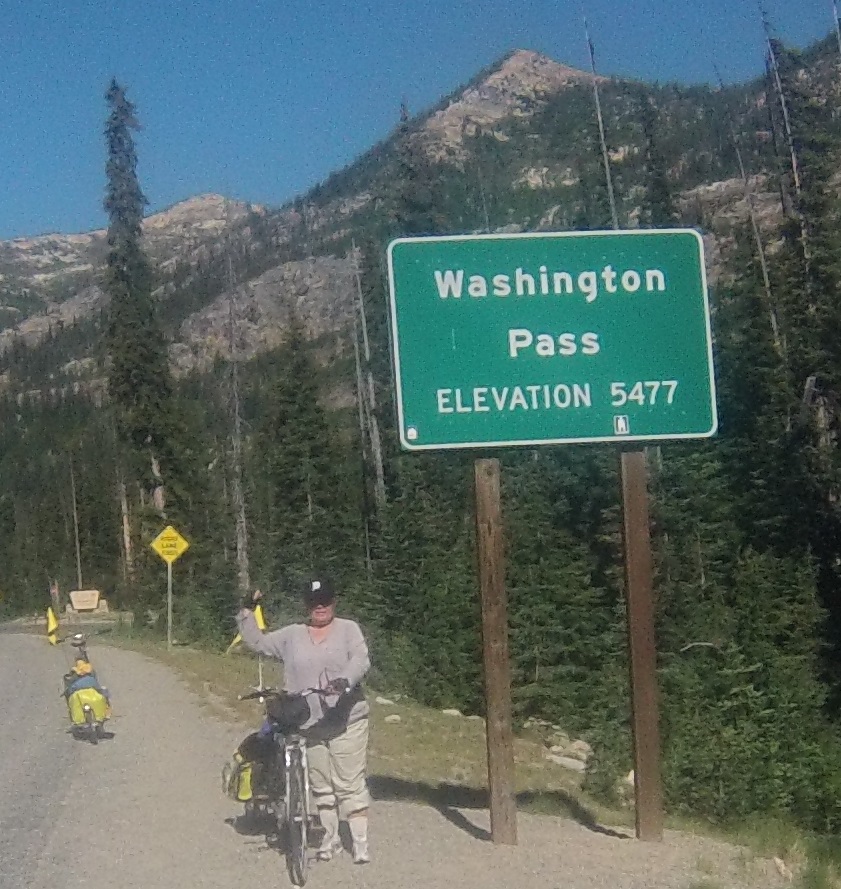
The next day—today—we wake up, eat the last of our supplies, and begin the trudge up the next mountain pass.    It is only 5 miles—a veritable lark after yesterday—and when clear the top, we are astounded.    We are in a cirque of straight walled peaks whose serrated jaggedness is both appalling and wonderful. 

The ride down is something else.  It is a straight shot down the mountain: 16 miles.  We have to pull our bikes to a stop every so often because our hands have gone numb from the shaking and braking. Wes and I agree, during one stop, that it would be terrible to have to go up this steep hill.  At one point, I note that it is a good thing I have brought the speed down to a more reasonable level, and when I check it, I am still going close to 27 miles an hour. 
We have already decided we are going to take a room when we get to the bottom.  I saw Freestone Inn and Cabins on the map and said, “Let’s try there.”  When we pull in, we see it is a lovely resort next to the Early Winters stream.

We get a cabin next to the creek, wash ourselves, and happily drink a cold beer.  We wash our stinky bike clothes in the sink and put them out in the hot, dry air. (I’m sure our neighbors like the look of clothes strung on the porch of our cabin).  We enjoy a wonderful meal and visit at length with the other guests.  It is really nice, especially remembering that just twenty four hours earlier, we were lurking in an illegal camp with no food or water, after a long brutal day.
We still have no phone service, but the inn has Wi-Fi, so I am able to get email.  The services for Judy will be in Riverton, Wyoming on Saturday, July 27, 2103  at 9 am.  There is no way for us to get there. 

We wonder about the curious ways we make it through our lives.  There are no promises.   Whether our lives stretch through years and years, and slowly wind down, like Rose’s, or blink out in an instant in a bizarre accident like Judy’s; whether we rush toward them in great hope and expectation, or slog our way through duties and obligations, it still is just as Samuel Beckett said, “The light gleams for an instant, then it’s darkness once more.”